The circle of fifths is a map of how the 12 keys relate to each other. That's really all it is. It looks intimidating because someone drew it as a wheel covered in sharps and flats, but once you know how to read it, it turns into one of the most useful cheat sheets in music.
By the end of this you'll know how to read the circle, where it actually came from (spoiler: not Pythagoras, no matter what half the internet says), and how to use it for key signatures, chords, and modulation. Let's get into it.
TABLE OF CONTENTS
What the circle of fifths actually is
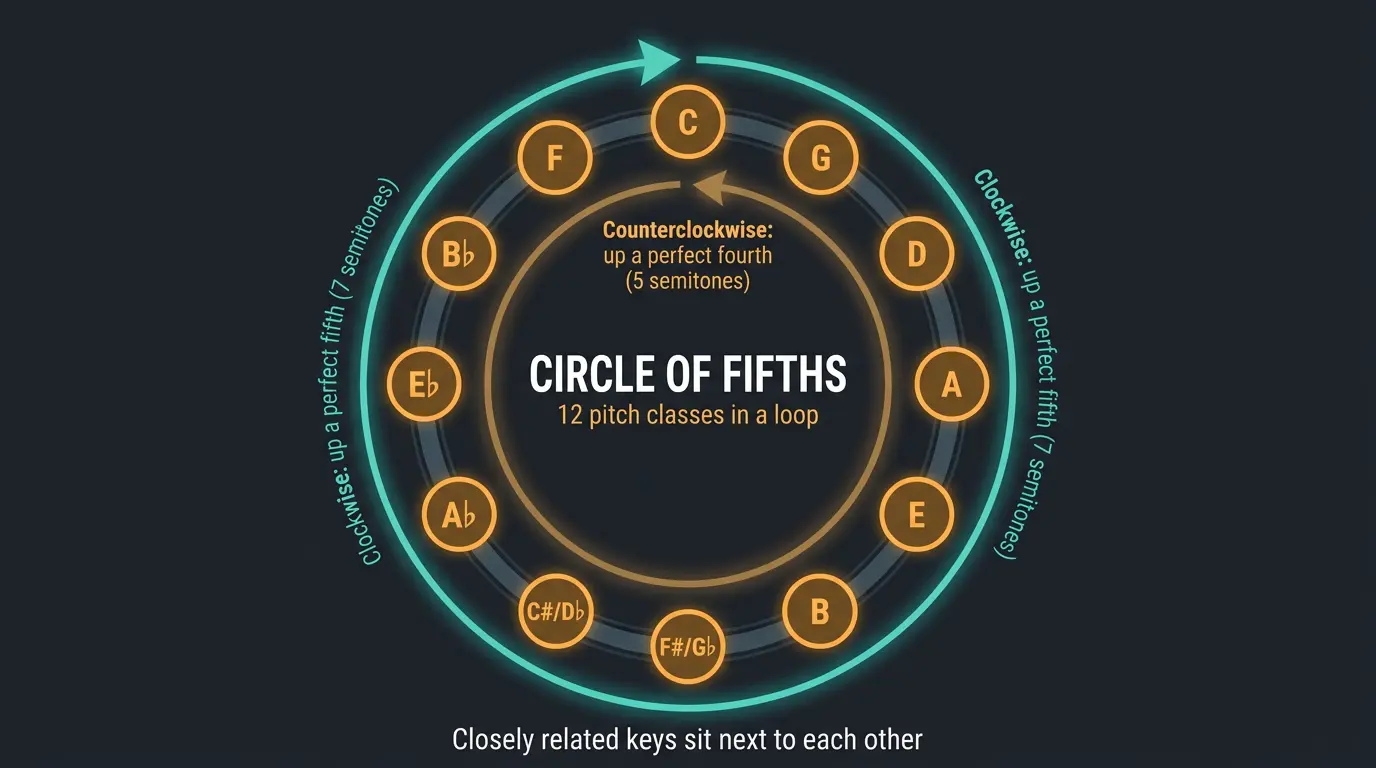
The circle of fifths arranges the 12 pitch classes of the chromatic scale in a loop of ascending perfect fifths. A perfect fifth is 7 semitones. So you start on C, count up a fifth to G, up another fifth to D, and keep going.
The full sequence is C, G, D, A, E, B, F#/Gb, C#/Db, Ab, Eb, Bb, F, and back to C. Because you're moving in fifths, the keys that are closely related end up sitting right next to each other. That's the whole trick, and it's why the circle is so handy.
One more thing. If you go counterclockwise instead, you're moving in perfect fourths (5 semitones each), which is why some people call it the circle of fourths. Same wheel, opposite direction.
How to read the circle
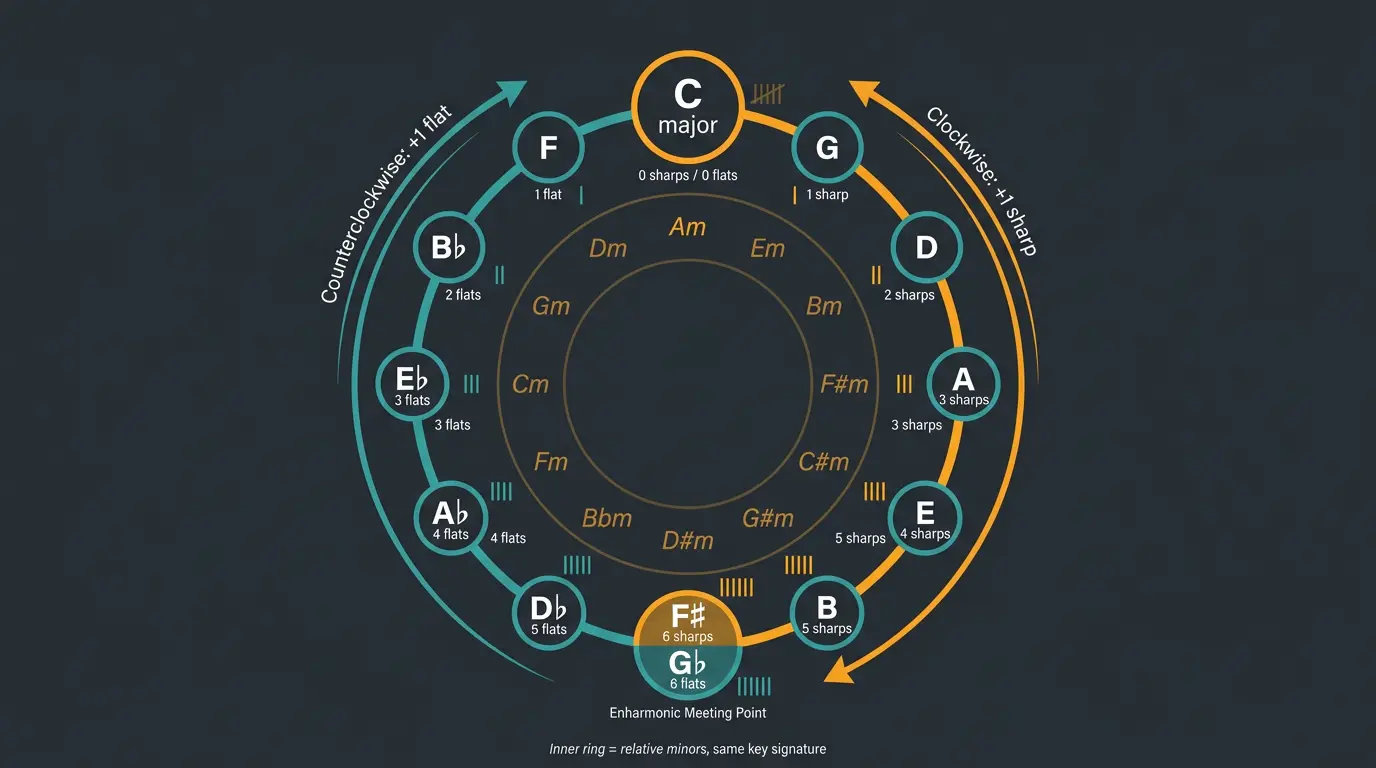
Start at the top with C major, which has no sharps or flats. Every step clockwise adds one sharp. C to G adds F#. G to D adds C#. Keep going and you eventually land on C# major with a whopping seven sharps. Go counterclockwise from C instead and you add flats the same way, all the way around to Cb major.
A scenario where this is useful: say you're staring at a piece in a key you don't have memorized. Instead of counting sharps by hand, you glance at the circle and read it off. The position tells you the key signature.
Inside the ring you'll find the relative minors. Each major key shares its key signature with the minor sitting inside it. G major and E minor both have one sharp. And at the bottom, 6 o'clock, the enharmonic keys meet up: F# and Gb are the same notes spelled two ways. If you want to go deeper on how those note names get chosen, our post on diatonic vs chromatic scales is a good next stop.
Where the circle of fifths really came from

Here's where a lot of blogs get it wrong, so let's set the record straight.
Pythagoras does belong in this story, but not the way people usually tell it. His actual contribution is the math behind the perfect fifth itself: the 3:2 string-length ratio that produces the interval. That's the acoustic root. He did not draw the circle. The claim that he invented the diagram gets repeated everywhere, and there's basically no evidence for it. Terminology and history both matter, so it's worth getting this right.
The first known circle-of-fifths diagram actually shows up much later, in the late 1670s. It was drawn by Nikolay Diletsky, a Ukrainian composer and theorist, in his composition treatise Grammatika (around 1677). He used it as a tool for teaching key relationships and modulation in the Western polyphonic style.
The version we'd recognize today came from the German Baroque composer Johann David Heinichen. He described a "Musicalischer Circul" in a 1711 work, then formalized it into a full 24-key modulation guide in Der Generalbass in der Composition (1728). Interesting detail: Heinichen had no idea Diletsky had beaten him to it decades earlier. You can read more about him in this overview of Johann David Heinichen.
The timing isn't a coincidence. The circle took shape right as the old church modes were giving way to the major and minor key system we use now. Later theorists like Sechter and Riemann built on Heinichen's work from there.
Why the circle only closes because of tuning
Here's a nice technical detail for the audio folks. In pure Pythagorean tuning, if you stack twelve perfect fifths, you don't actually land back where you started. You overshoot by a small amount called the Pythagorean comma. The circle doesn't quite close.
What lets the 12 notes wrap around cleanly is equal temperament, where each fifth is shaved just slightly out of tune so everything lines up. So the tidy little wheel you're looking at only works because of the tuning system underneath it. No comma, no clean circle.
How to actually use it
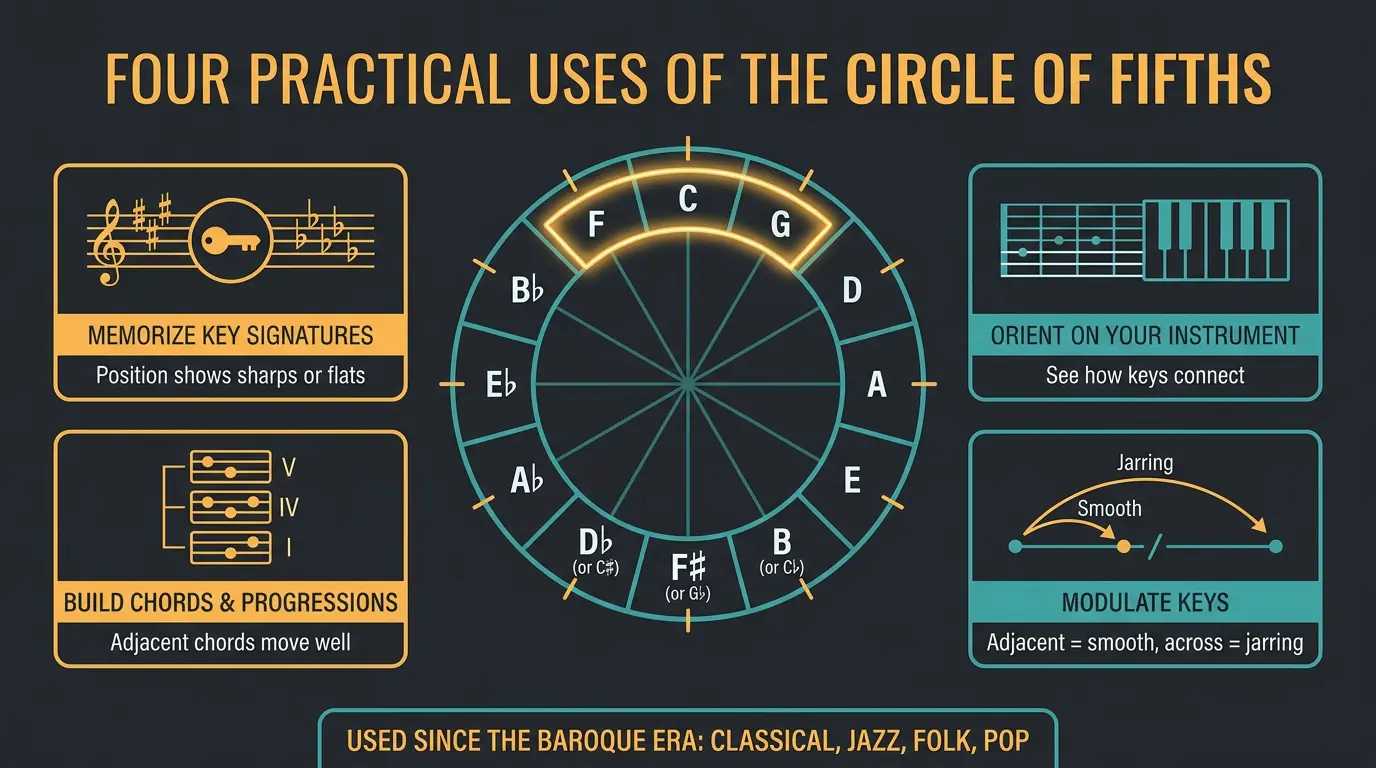
This is the part that pays off. The circle is great for a few practical jobs:
- Memorizing key signatures. Position on the wheel tells you how many sharps or flats a key has.
- Orienting yourself on an instrument. It maps out how keys connect, which helps when you're jumping around.
- Building chords and progressions. Adjacent chords tend to sound good moving to each other. If you're writing, our guide on how to write chord progressions pairs well with this.
The big one is modulation. Because closely related keys sit next to each other, the circle doubles as a modulation cheat sheet. Move to an adjacent key and the shift sounds smooth. Jump across the wheel and it sounds jarring, which is sometimes exactly what you want. Less is more here, so pick your moves with intention.
This isn't a classical-only tool, either. Ever since the Baroque era it's shown up across classical, folk, jazz, and pop. A concrete example: the B section of Gershwin's "I Got Rhythm" moves through four key centers in eight bars, all following the circle. That progression became so common jazz players just call it "rhythm changes."
Quick things to remember
- Clockwise adds sharps, counterclockwise adds flats.
- Relative minors sit inside the ring, sharing a key signature with their major.
- Adjacent keys are the most closely related, which makes them smooth to modulate between.
- The circle only closes cleanly because of equal temperament; pure Pythagorean fifths don't quite line up.
Frequently Asked Questions (FAQs)
Who invented the circle of fifths?
The first known circle-of-fifths diagram was drawn by Nikolay Diletsky, a Ukrainian composer and theorist, in his treatise Grammatika around 1677. The modern form came later from Johann David Heinichen, who formalized a full 24-key version in 1728, unaware that Diletsky had done it decades earlier.
Why is it called the circle of fifths?
It's called the circle of fifths because each step around the wheel moves up a perfect fifth, which is 7 semitones. Start on C, go up a fifth to G, then D, and so on until you loop back to C. Going the other direction moves in fourths, so some people call it the circle of fourths instead.
What's the difference between the circle of fifths and fourths?
There's no real difference, just direction. Moving clockwise, you ascend in perfect fifths (7 semitones). Moving counterclockwise, you ascend in perfect fourths (5 semitones). It's the same wheel with the same keys, so "circle of fourths" is just the counterclockwise way of reading it.
Do I need to memorize the circle of fifths?
You don't need to memorize it, but it helps a lot. Knowing it lets you recall key signatures and spot closely related keys without stopping to count. Plenty of great musicians keep a printout nearby instead. Trust your ears first, and let the circle point the way when you get stuck.
Did Pythagoras invent the circle of fifths?
No, Pythagoras did not invent the circle of fifths, despite what a lot of blogs claim. His real contribution is the 3:2 ratio that produces a perfect fifth, which is the acoustic foundation underneath it. But the actual diagram didn't appear until the late 1670s with Nikolay Diletsky, over two thousand years later.
Final Thoughts
The circle of fifths isn't magic and it isn't ancient wisdom handed down from Pythagoras. It's a practical map that a couple of Baroque-era theorists worked out to make key relationships easier to see. Once you can read it, it quietly speeds up everything from writing progressions to picking a key to modulate into.
Keep one nearby, use it when you're stuck, and let your ears make the final call. That's the whole point of it.
Some of the links within this article are affiliate links. These links are from various companies such as Amazon. This means if you click on any of these links and purchase the item or service, I will receive an affiliate commission. This is at no cost to you and the money gets invested back into Audio Sorcerer LLC.