Here's the whole thing in one breath: the chromatic scale is the full set of 12 notes, and a diatonic scale is a 7-note selection carved out of those 12. That's the core of it. Everything else is detail.
This is foundational theory, so it doesn't change. A diatonic scale worked the same way 300 years ago as it does today. The problem isn't that it's hard — it's that most explanations make it harder than it needs to be.
So let's define both plainly, show exactly how they relate, and then look at how the difference actually shows up when you're writing and producing. No jargon wall.
TABLE OF CONTENTS
What a diatonic scale actually is
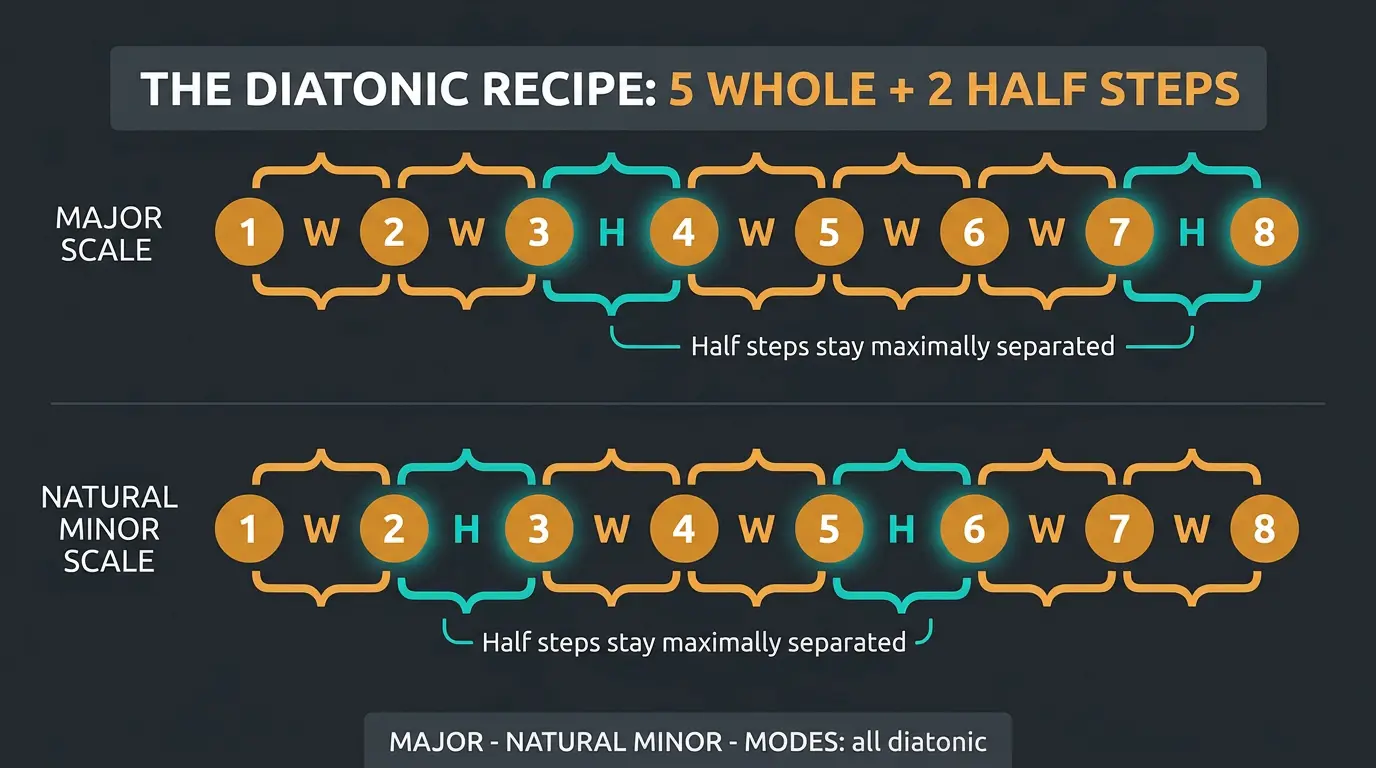
A diatonic scale is a seven-note (heptatonic) scale made of five whole steps and two half steps per octave. The key detail most explanations skip: those two half steps are always maximally separated from each other, with either two or three whole steps between them. That spacing is what gives diatonic music its pull toward a home note.
The major scale follows this pattern: whole, whole, half, whole, whole, whole, half. In a major scale, the half steps land between the 3rd and 4th degrees and between the 7th and the octave.
The natural minor scale is whole, half, whole, whole, half, whole, whole. Here the half steps fall between the 2nd and 3rd and between the 5th and 6th degrees.
One thing worth clearing up: "diatonic" isn't a single scale. Major, natural minor, and all the modes are diatonic — they're all built from that same five-whole-two-half recipe, just starting in different places. The word itself comes from the Greek for "through tones." If you want the deep reference, the Wikipedia entry on the diatonic scale goes further than most people need.
The seven modes and diatonic chords
The seven diatonic modes are Ionian, Dorian, Phrygian, Lydian, Mixolydian, Aeolian, and Locrian. Two of those you already know under other names — Ionian is the major scale, and Aeolian is the natural minor. If you want to go deeper on this, we've got a whole piece on what music modes are.
Diatonic harmony works the same way. Build a chord on each degree of the scale and you get seven chords: I, ii, iii, IV, V, vi, and vii°. A progression like C–F–Am–G is diatonic because every chord stays inside C major. Nothing sneaks in from outside the key.
What a chromatic scale actually is
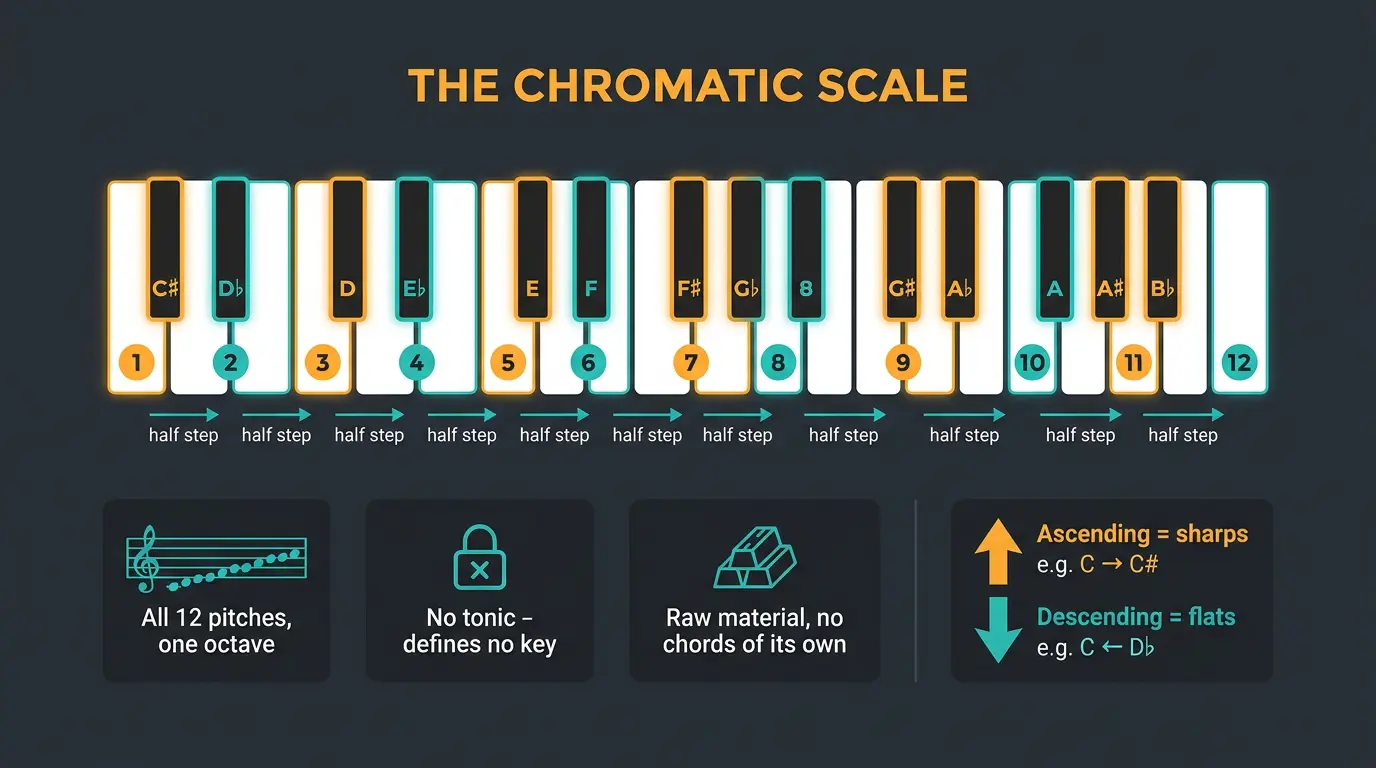
A chromatic scale is all twelve pitches in an octave, with every adjacent note exactly a half step apart. On a piano, that's every black and white key in one octave, played in order. No gaps, no whole steps — just twelve even half steps.
Here's what makes it different from major and minor: it has no tonic. It doesn't matter where you start, the chromatic scale always contains the same 12 notes. So it defines no key, and it has no chords of its own. It's just the raw material everything else is built from.
The name comes from the Greek chroma, meaning color. That's a good hint at its job — traditionally it's used to color and add tension to diatonic music, not to stand on its own. One small notation convention: an ascending chromatic scale is usually written in sharps, and a descending one in flats, though real music bends that rule depending on the key.
How the two scales relate
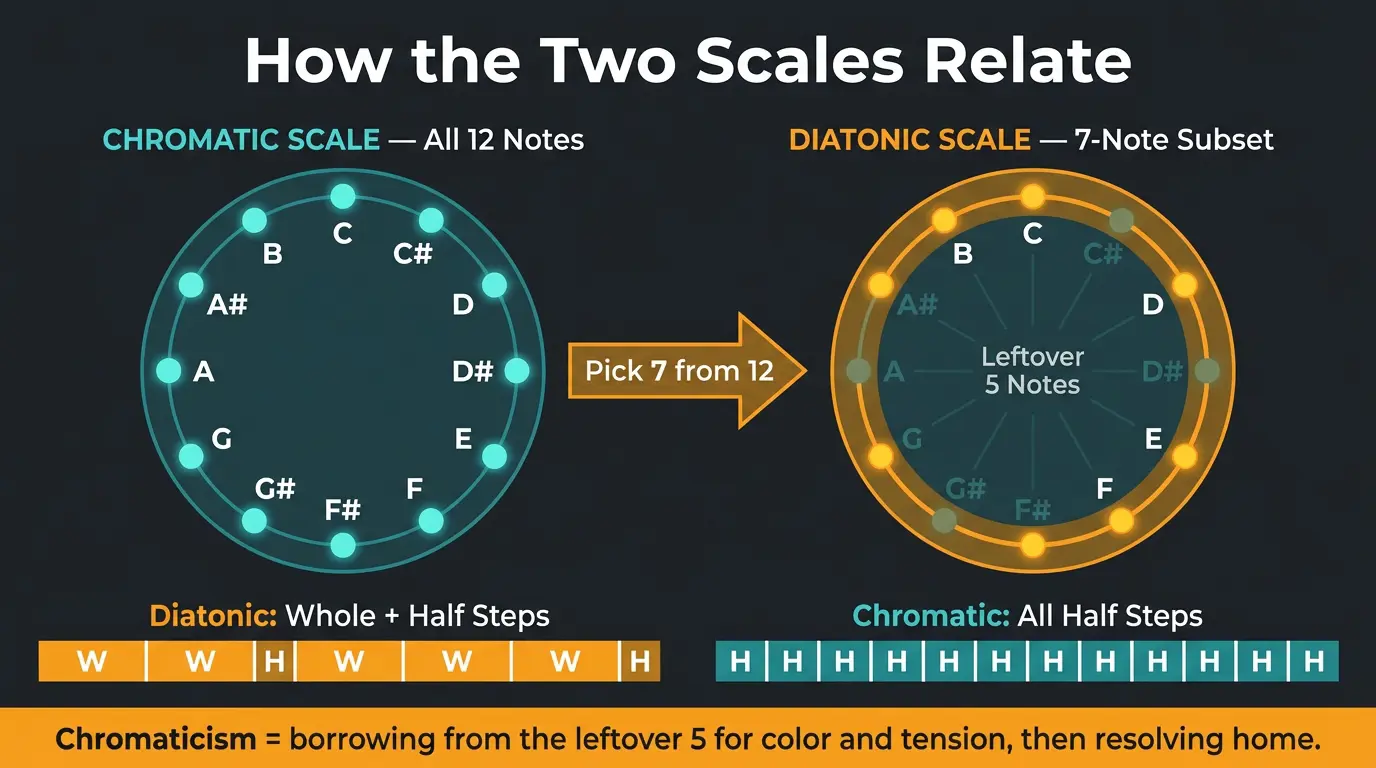
This is the part that ties it together. The chromatic scale is the superset — all 12 notes. A diatonic scale is a 7-note subset carved out of those 12. Same pool of notes, you just pick seven of them in a specific pattern.
The construction is the other clean contrast. Diatonic mixes whole and half steps. Chromatic is nothing but half steps. That's it.
So what's chromaticism? It's bringing in some of the five notes your diatonic scale left behind. You've got a key, you've got your seven notes, and then you reach outside for one or two of the leftovers to add color and tension before settling back home. Beginners can hear that. Pros already do it without thinking about it.
The difference in a nutshell
- Diatonic is 7 notes built from whole and half steps. It has a tonic (a home note) and its own set of diatonic chords.
- Chromatic is 12 notes, all half steps. It has no tonic and no chords of its own — it's key-independent.
- Chromatic is the full palette of notes. Diatonic is the selection you pull from it to build a key.
How chromaticism shows up in real music

You'll almost never hear a full chromatic scale played straight through in a song. What you hear instead is the odd note that feels like it doesn't quite belong, a moment of tension, or a chord that pulls you outside the key and then back home.
It shows up two ways. Melodically, chromatic notes work as passing tones or neighbor tones — small half-step moves that slide between the diatonic notes. Harmonically, it means using chords built on notes outside the key, like borrowed chords or a chromatic modulation into a new area.
Two real examples. The guitar part in "Blackbird" runs a chromatic bass line underneath a diatonic melody. And the "Creep" chorus (G–B–C–Cm) leans on that shift from a major to a minor chord to get its whole aching quality.
If you're new to this, start small. Make sure you keep your chords diatonic and just move a bass line chromatically underneath them — that alone gets you a lot of mileage. Used right, this is one of the most reliable tension-and-release tools in pop. If you want to build on it, our guide to borrowed chords and modal interchange picks up right where this leaves off.
Where the 12-note system came from
The 12 even half steps we use come from equal temperament, which divides the octave into twelve equal parts. That idea got developed around Bach's time, though the push started earlier — in 1584, Vincenzo Galilei (father of the astronomer) proposed a 12-tone system and wrote 24 songs to show it off, one in each major and minor key. In the early 20th century, Schoenberg took it further with his twelve-tone technique, treating all 12 notes as equal with no tonic at all.
Here's the honest nuance most theory posts leave out: the 12-note chromatic system isn't universal. Plenty of musical traditions use different tunings, and some use intervals smaller than a half step. It's the system Western music happened to land on — not the only way to slice an octave.
Frequently Asked Questions (FAQs)
Is the chromatic scale a real scale or just all the notes?
It's both, technically. The chromatic scale is a real, defined scale — all 12 pitches in an octave, each a half step apart — but because it contains every note, it has no tonic and no key. So it functions more like the full pool of notes than a scale you'd write a melody in.
Can a diatonic scale be minor?
Yes. The natural minor scale is diatonic — it's built from the same five whole steps and two half steps as the major scale, just arranged differently. Harmonic minor is the exception, because its augmented second breaks the diatonic pattern.
Is the pentatonic scale diatonic?
No, the pentatonic scale is not diatonic. Diatonic means seven notes with that specific whole-and-half-step pattern. Pentatonic has five notes, so it doesn't qualify. Octatonic and whole-tone scales are non-diatonic too, for the same reason — wrong number of notes and wrong step pattern.
What's the difference between chromatic and atonal?
Chromatic music uses notes outside the key to add color while still having a home key. Atonal music has no key or tonic at all. You can be heavily chromatic and still be firmly in a key — think of a bluesy solo. Atonal throws the whole idea of home out.
Do I need to know this to write good songs?
No, you don't need the terminology to write good songs — plenty of great writers work by ear. But knowing why a note sounds "outside" helps you do it on purpose instead of by accident. Trust your ears first, and let the theory explain what they already told you.
Final Thoughts
Strip away the vocabulary and it's simple: 12 notes total, pick 7 for your key, and chromaticism is just borrowing back a few of the five you set aside. Diatonic gives you home. Chromatic gives you the color you reach for when you want to leave home and come back.
You don't need to memorize any of this to use it. Move a bass line by half steps under your next progression and listen to what happens. That's the whole thing in action — no magic, just the work.
Some of the links within this article are affiliate links. These links are from various companies such as Amazon. This means if you click on any of these links and purchase the item or service, I will receive an affiliate commission. This is at no cost to you and the money gets invested back into Audio Sorcerer LLC.