Modes get made way harder than they need to be. In plain terms, a mode is the major scale heard from a different home note — and there are seven of them.
That's the whole idea. Most tutorials wrap it in ancient history and Greek names before they tell you what actually matters. We'll skip the fog. Here's what each mode is, how each one sounds, how to hear them, and real songs that use them. Plus we'll clear up a history myth that gets repeated everywhere.
TABLE OF CONTENTS
What a mode actually is
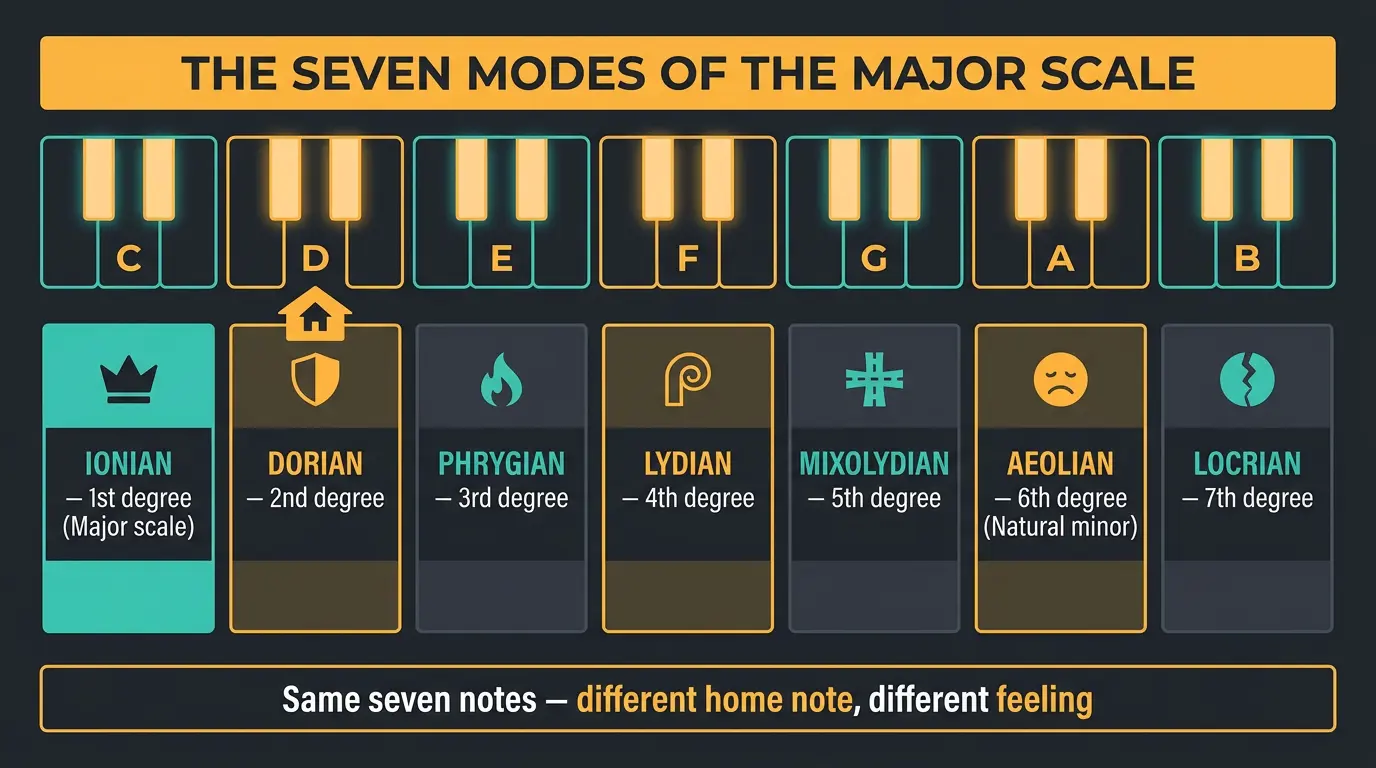
Take the notes of a major scale. Now, instead of treating the first note as home, treat a different note as home. Same notes, different tonal center, completely different feeling. That's a mode.
Play C major but treat D as home and you get D Dorian. Same seven notes as C major, but the ear hears something new because the gravity shifted. The home note is what everything resolves back to, and moving it changes the whole character.
There are seven modes, one for each degree of the major scale:
- Ionian — starts on the 1st degree (this is just the major scale)
- Dorian — starts on the 2nd
- Phrygian — starts on the 3rd
- Lydian — starts on the 4th
- Mixolydian — starts on the 5th
- Aeolian — starts on the 6th (this is the natural minor scale)
- Locrian — starts on the 7th
Two ways to think about modes
There are two mental models, and both are useful depending on what you're doing.
The relative approach is what we just did — every mode from C major shares the exact same notes. C Ionian, D Dorian, E Phrygian, and so on, all pull from the same pool. This one's great for playing, because you already know the notes. You're just shifting where home is.
The parallel approach builds every mode from the same root: C Ionian, C Dorian, C Phrygian, C Lydian, all starting on C. This one's better for hearing the difference, because the root stays put and only the flavor changes. Same starting note, different mood. When you want to actually compare how two modes feel, parallel is the way to do it.
Major, minor, or something in between
A quick way to sort the modes is by the quality of their home chord — the triad built on the tonic.
- Major tonic: Ionian, Lydian, Mixolydian
- Minor tonic: Dorian, Phrygian, Aeolian
- Diminished tonic: Locrian
With that being said, calling them plain major or minor sells them short. They're flavors. Lydian and Mixolydian are both major, but Lydian floats along all calm and dreamy while Mixolydian has this driven, positive push to it. Both minor-leaning modes have their own thing too. If you want the deeper background on the two poles these fall between, we've got a whole piece on how major and minor chords shape the sound of music.
How to hear each mode by its character note
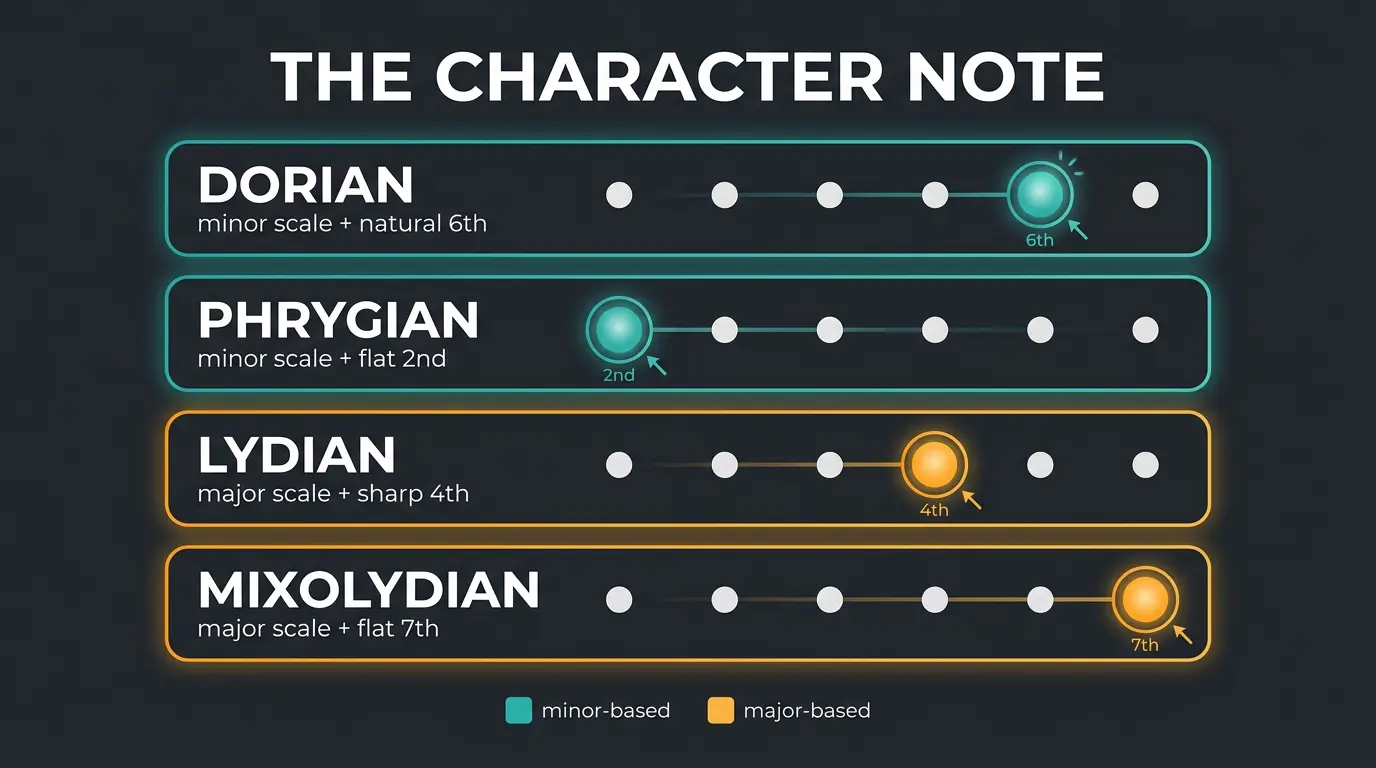
Here's the single most useful thing in this whole post. Each mode is basically a major or minor scale with one note altered — and that one note is what gives it away.
- Dorian — minor scale with a natural 6th
- Phrygian — minor scale with a flat 2nd
- Lydian — major scale with a sharp 4th
- Mixolydian — major scale with a flat 7th
Once you know the character note, identifying a mode by ear gets a lot easier. You're not listening for seven notes — you're listening for the one that bends the mood away from plain major or minor.
Fair warning: these differences can be subtle in a busy mix. Make sure you're listening closely, ideally on headphones, so that one altered note doesn't get buried.
The seven modes and what they sound like
Here's a quick profile of each so you know what you're reaching for.
- Ionian — the major scale. Bright, resolved, familiar. Nothing exotic, and that's the point.
- Dorian — minor with a lift. That natural 6th keeps it from feeling too sad. It works beautifully over minor chords and shows up all over pop, which makes it a friendly first mode to explore.
- Phrygian — dark and tense, with a Spanish or Middle Eastern flavor from that flat 2nd. It's a metal staple for a reason.
- Lydian — dreamy and floating. This is the film, TV, and game composer's secret weapon. Rare in pop, common when a scene needs to feel wide-open or magical.
- Mixolydian — bluesy and rock-flavored, the major scale with a flat 7th. It's also called the dominant scale, and guitarists lean on it constantly.
- Aeolian — the natural minor scale. The default somber minor, and probably the mood you already reach for without thinking.
- Locrian — the odd one out. Its home chord is diminished, which sounds so unstable that it's genuinely hard to make music that resolves. You'll mostly find it in jazz improvisation rather than written songs.
Where the names really come from
You'll read everywhere that these modes are ancient Greek scales handed straight down to us. That's not quite true, and the real story is worth getting right.
The Greek-derived names got applied — and partly misapplied — to medieval church modes back in the 9th century. Scholars of the day misread a text by Boethius, who'd translated Greek music theory into Latin a few centuries earlier. The Greeks counted their intervals from the top down; the medieval scholars counted from the bottom up, and things got jumbled. So the names we use don't actually line up with how the Greeks used them.
The old church system had eight modes, arranged in authentic and plagal pairs — think Dorian and Hypodorian — that have no direct modern counterpart. And Ionian and Aeolian, the two you probably know best? Those were late additions, tacked on in the 16th century by the Swiss theorist Glareanus. The tidy seven-mode system we use today is a later simplification, not a straight inheritance from ancient Greece.
Real songs that use modes

Theory sticks better when you can hear it. Let's give it a listen through some songs you might already know.
- Dorian — "Scarborough Fair" and the sea shanty "Drunken Sailor" both live here. That minor-with-a-lift quality is all over folk.
- Phrygian — flamenco guitar and a huge chunk of metal. The flat 2nd is doing the heavy lifting.
- Mixolydian — the "na na na" outro of "Hey Jude" is textbook, with its I–bVII–IV move (F–Eb–Bb). "Sweet Home Alabama" rides the same idea.
- Lydian — mostly a screen sound. The Simpsons theme opens on it, and "Define Dancing" from Wall-E uses that dreamy Lydian chord movement.
One honest caution: a lot of "songs in X mode" lists online are unreliable. Plenty of them are really just ordinary diatonic songs where the home chord happens to sit in a weak spot or drop out entirely. So take those lists with a grain of salt, and trust your own ears over a random ranking. If you want to dig deeper into how modes get used in writing, Berklee has a solid rundown on major and minor modal scales. And if you're curious how this connects to writing progressions outside the plain major or minor world, our guide to borrowed chords and modal interchange picks up right where this leaves off.
Quick recap
- A mode is the major scale heard from a different home note — same notes, different tonal center.
- There are seven: Ionian, Dorian, Phrygian, Lydian, Mixolydian, Aeolian, and Locrian.
- Each mode has one character note that gives it away — like Lydian's sharp 4th or Mixolydian's flat 7th.
- The Greek names are a historical mislabel from the 9th century, not a direct inheritance from ancient Greece.
Frequently Asked Questions (FAQs)
How many modes are there?
There are seven modes: Ionian, Dorian, Phrygian, Lydian, Mixolydian, Aeolian, and Locrian. Each one starts on a different degree of the major scale. Ionian is the major scale itself, and Aeolian is the natural minor scale, so two of the seven are scales you probably already know.
What's the difference between a mode and a scale?
A mode is a type of scale — specifically, a scale you get by treating a different note of the major scale as home. All modes are scales, but not all scales are modes. The word "mode" just highlights that same notes can produce very different sounds depending on where home is.
Which modes are major and which are minor?
Ionian, Lydian, and Mixolydian have a major home chord, so they lean major. Dorian, Phrygian, and Aeolian have a minor home chord, so they lean minor. Locrian is the outlier with a diminished home chord. That said, calling them plain major or minor undersells the distinct flavor each one brings.
How do I use modes when writing or improvising?
Pick a mode by its mood, then let its character note shine — Dorian over minor chords, Mixolydian over dominants, Lydian over a major chord with a raised 4th. The trick is keeping your home note strong so the ear actually settles there. Otherwise it just sounds like an ordinary key.
Why is Locrian barely used?
Locrian is rarely used because its home chord is diminished, which sounds unstable and refuses to resolve cleanly. It's tough to write music that feels settled when home never sounds like home. You'll mostly hear it in jazz improvisation, where players use it over specific chords rather than as a whole song's foundation.
Final Thoughts
Modes aren't magic and they aren't ancient secret knowledge — they're the major scale seen from seven different angles. Once you can hear the one character note that defines each, the whole thing clicks and you stop needing the charts.
So play around. Build a mode from a single root, sit on the home note, and listen for what makes it feel different. Trust your ears — they'll teach you more than any name ever will.
Some of the links within this article are affiliate links. These links are from various companies such as Amazon. This means if you click on any of these links and purchase the item or service, I will receive an affiliate commission. This is at no cost to you and the money gets invested back into Audio Sorcerer LLC.