Clipping gets treated like a four-letter word, and that reputation is only half right. Yes, digital clipping can wreck a mix. But the full story is more useful than "never let it happen."
Here's what we'll cover: what clipping actually is, why digital and analog clipping sound so different, and where deliberate clipping earns its keep in modern mastering. We'll also get into 32-bit float recording and streaming loudness, because both of them change the old rules more than most people realize.
TABLE OF CONTENTS
What audio clipping actually is
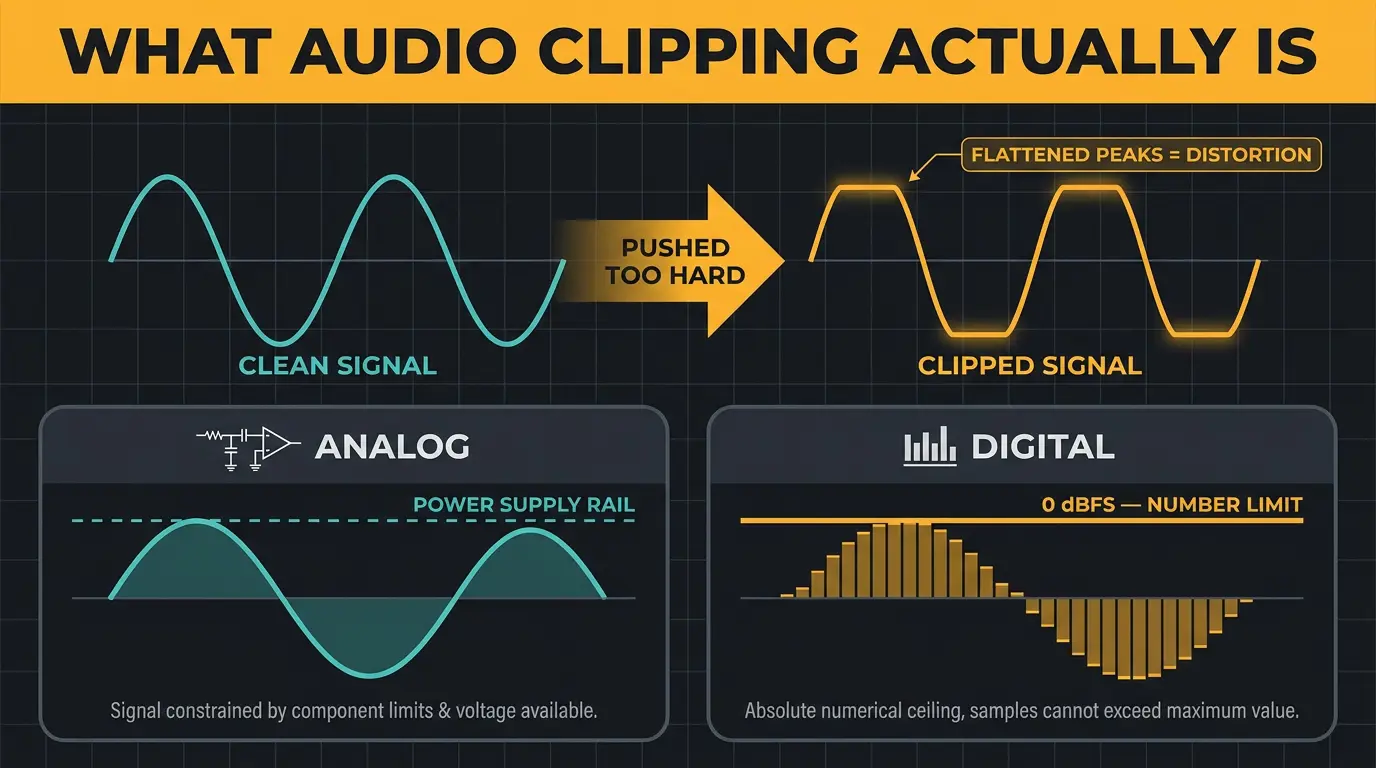
Clipping happens when a signal overloads the system carrying it and the peaks get flattened. The system simply can't handle how big the signal is, so it lops the tops off.
There are two main cases. In the analog world, the signal voltage pushes up toward the power supply rail of the circuit and can't go any higher. In the digital world, a sample tries to exceed the number range the system has to store it, and it hits a hard wall.
Picture a smooth sinewave. Push it too hard and the rounded peaks start flattening into a squarewave. That flattening is the distortion you hear. If you want a deeper reference, Sound On Sound has a solid glossary entry on clipping worth bookmarking.
Why digital clipping sounds harsher than analog
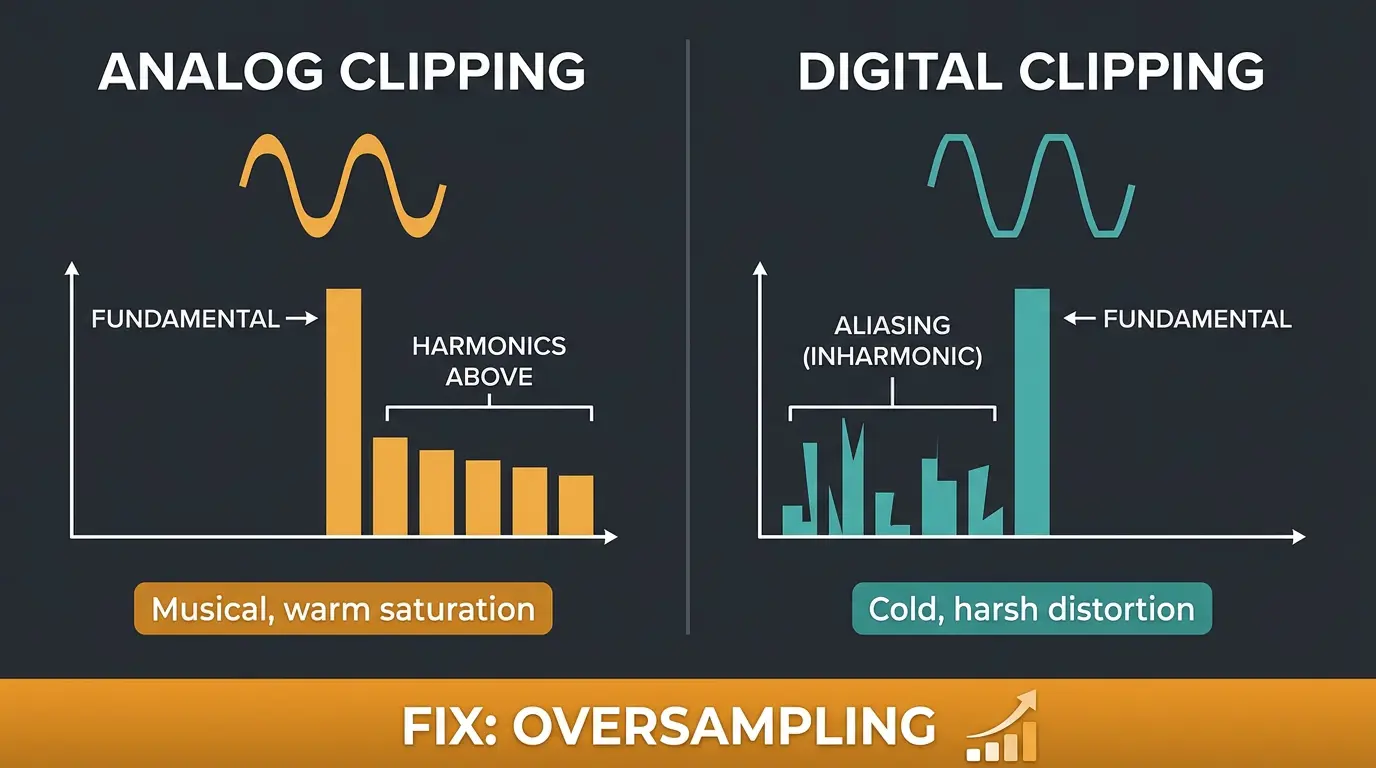
You've probably heard the old shorthand: analog clipping is "rounded" and digital clipping is "square." That's an oversimplification, and it misses the real reason they sound so different.
The real difference is in the harmonics. When analog gear clips, it produces harmonic distortion above the fundamental frequency. That's the warm, pleasing saturation people chase from tubes and tape. It sits musically on top of the sound.
Digital clipping is a different animal. Those same high-frequency harmonics get folded back down as aliasing, creating inharmonic distortion below the fundamental. Those tones don't relate to the note you played, which is exactly why digital clipping sounds cold and nasty. Let's give it a listen sometime and it's obvious in an instant. The modern fix is oversampling, which most good clipper plugins use to keep those artifacts in check.
Is digital clipping always a bad thing?
Here's the honest reframe. The old rule that "digital clipping is never acceptable" is outdated. Intentional soft or hard clipping is a mainstream mastering tool, and it's used deliberately to hit higher loudness with less of the pumping you get from heavy limiting.
And I'll say it plainly: louder, used right, does sound better. There's no need to apologize for pushing levels when the material calls for it.
With that being said, let's stay balanced. A well-set limiter handles the large majority of projects cleanly, with no clipper anywhere in the chain. Whether clipping helps depends on the mix and the genre. There isn't a universal right answer here, so decide with your ears.
How 32-bit float recording changes the rules
This one genuinely rewrites part of the old story. 32-bit float stores each sample in a floating-point format, a bit like scientific notation. That gives it a nearly infinite dynamic range.
What that means in practice: a recording that peaks well into the red in your DAW hasn't actually clipped. You can pull the level back down in post and the detail is still there. That's a big deal compared to 16 or 24-bit, where clipping permanently throws data away.
Now the caveat, because plenty of articles get this wrong. 32-bit float only protects you inside the digital domain. There are no 32-bit float ADCs, so if you overload the analog front end, your mic or your preamp, that stage can still genuinely clip. No amount of float math fixes an overloaded input.
A couple more honest notes. 32-bit float files run about 33% larger than 24-bit, and it won't rescue a bad mic choice or sloppy placement. And if you're still working in 16 or 24-bit, standard gain staging applies. Make sure your peaks land roughly between -12 and -6 dBFS so you've got a safe buffer.
Clipping, limiting, and streaming loudness
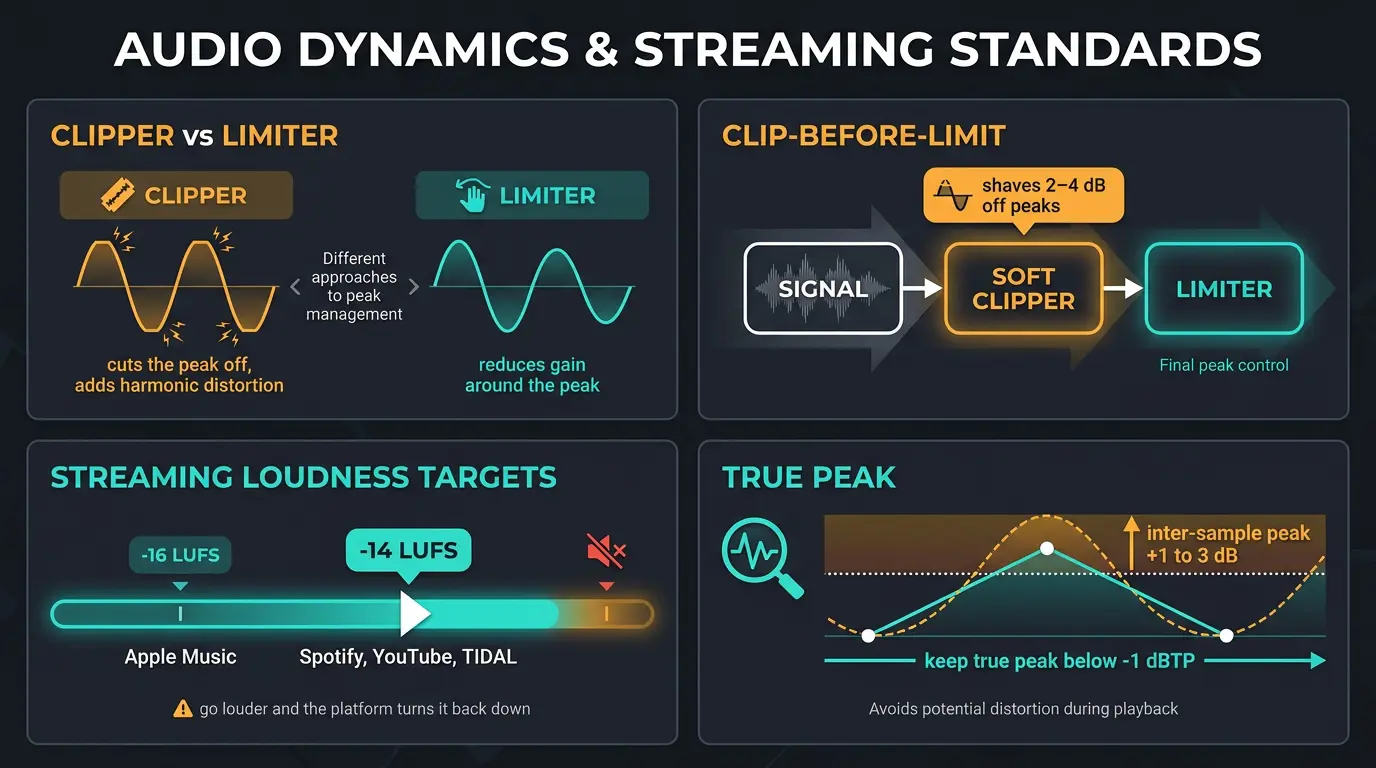
Most people reach for clipping for one reason: loudness. So it's worth being clear on how a clipper and a limiter differ, because they're not the same tool.
A limiter turns the signal down around a peak using gain reduction. A clipper cuts the peak off, reshaping the waveform and adding harmonic distortion in the process. Different mechanisms, different sound.
The modern workflow that ties them together is clip-before-limit. Drop a soft clipper ahead of your limiter and it can shave 2 to 4 dB off your peaks before they ever hit the limiter. That means the limiter works less hard, and the result often sounds more open at the same loudness. Used lightly it's transparent. Push it too far and the distortion gets obvious fast, so less is more.
Here's the part that changes the whole calculus, though. Streaming platforms normalize loudness. Spotify, YouTube, and TIDAL land around -14 LUFS; Apple Music sits closer to -16. If you brute-force a track way louder than that, the platform just turns it back down, and you gave up dynamics for nothing. If loudness targets are new to you, our guide to LUFS and loudness breaks it all down.
Last piece: true peak. When your digital file gets converted to analog or transcoded to a lossy format, the waveform between samples can rise higher than any single sample shows in your DAW. Those are inter-sample peaks, and they can push 1 to 3 dB above your sample peak. That's why you keep your true peak below -1 dBTP, and why our true peak limiting guide is worth a read if you master your own work.
Quick rules of thumb
- Analog clipping can sound warm and musical; digital clipping usually doesn't, thanks to aliasing.
- 32-bit float saves you inside the DAW, but it won't save you at the mic or preamp input.
- A soft clipper before your limiter can add loudness transparently when you use it lightly.
- Keep your true peak below -1 dBTP so nothing distorts after streaming platforms encode your track.
Frequently Asked Questions (FAQs)
Is all clipping bad?
No, not all clipping is bad. Analog clipping produces warm harmonic distortion that sounds pleasing on tubes and tape, and intentional soft clipping is a real mastering tool for loudness. Digital clipping by accident usually sounds harsh and cold, so that's the kind you want to avoid.
What's the difference between clipping and limiting?
A limiter turns the signal down around a peak using gain reduction, preserving the waveform shape. A clipper cuts the peak off entirely and adds harmonic distortion. Limiters are cleaner for most work, while clippers can grab a few extra dB of loudness, especially placed ahead of a limiter.
Does 32-bit float mean I can't clip?
Not exactly. 32-bit float has nearly infinite dynamic range, so a recording that peaks into the red in your DAW hasn't truly clipped and can be recovered. But there are no 32-bit float ADCs, so an overloaded mic or preamp can still clip at the analog input before the signal ever gets digitized.
What is true peak and why -1 dBTP?
True peak accounts for inter-sample peaks, the moments where the analog waveform rises higher than any single digital sample shows. Those peaks can jump 1 to 3 dB above your sample peak. Keeping true peak below -1 dBTP leaves headroom so your track doesn't distort after lossy streaming encoding.
Can clipping ever make a mix sound better?
Yes, used carefully. A light soft clipper before your limiter can shave 2 to 4 dB of peaks so the limiter works less hard, often giving you a more open, punchy master at the same loudness. Overdo it and the distortion becomes obvious and harsh, so keep it subtle.
Final Thoughts
Clipping isn't the villain it gets made out to be. It's a tool with a sound, and like any tool, it's about knowing when it helps and when it hurts. Digital clipping by accident is still worth avoiding, but deliberate clipping in the right spot is completely fair game.
The old absolutes have loosened up, mostly thanks to 32-bit float and streaming normalization. So learn what these things actually do, trust your ears over the rulebook, and remember that a little goes a long way.
Some of the links within this article are affiliate links. These links are from various companies such as Amazon. This means if you click on any of these links and purchase the item or service, I will receive an affiliate commission. This is at no cost to you and the money gets invested back into Audio Sorcerer LLC.