Delay does a lot more than repeat a sound. Used well, it adds depth, space, and movement — the difference between a vocal that sits flat and one that feels alive.
Here's the honest truth up front: there's no single best delay plugin. There's only the one that fits your track and the way you like to work. A delay you understand and reach for instantly beats a fancier one you never quite figure out.
So we're covering five, from studio workhorses to characterful tape echoes. Some are simple, some are deep, and one of them can probably make your coffee. Let's give them a listen.
TABLE OF CONTENTS
How we picked these delay plugins

These five cover different jobs, not the same job five times. You've got a flexible studio staple, a beginner-friendly option, a deep multi-model box, a vintage tape emulation, and an all-rounder that does a little of everything.
Less is more here, and it's a real philosophy — a delay you actually understand will always beat one with a hundred knobs you never touch. Every pick on this list is in-the-box. The old "you need real hardware" argument is dead. These plugins hold their own against the gear that inspired them, so pick based on workflow and sound, not on some idea that software is second-rate. If you're into that world of vintage color, our roundup of tape emulation plugins pairs nicely with a good tape echo.
Waves H-Delay
#1
Top Pick
Waves H-Delay
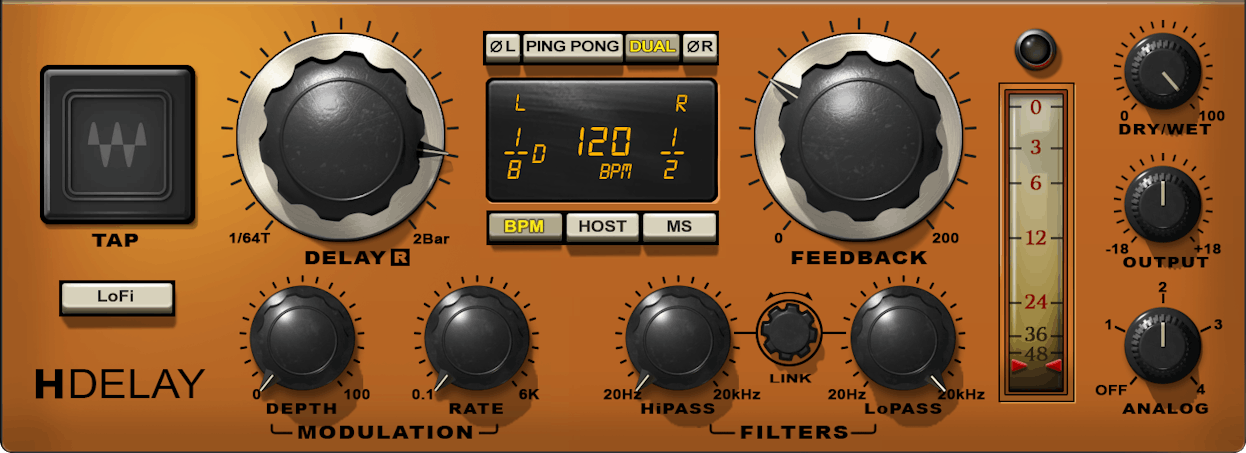
H-Delay has been a studio staple for years, and it still holds up. It's warm, characterful, and flexible enough to cover slapbacks, filtered dub delays, tempo-synced repeats, analog-style modulation, and a bit of LoFi grit when you want it.
A scenario where this might be useful: you've got a lead vocal that feels a little dry and you want a simple slapback to fatten it up. Dial in a short delay time, a touch of feedback, and it just works — no menu diving. That's the appeal.
Honest note: some people are consolidating into fewer plugin ecosystems these days, purely for workflow reasons, not because anything's wrong with H-Delay. If you're already in the Waves world, this one earns its spot in the chain.
Pros
- Warm, musical character that suits vocals and guitars
- Fast to dial in a good slapback or dub delay
- Analog-style modulation and LoFi options built in
Cons
- Some users are moving away from the Waves ecosystem for workflow reasons
Baby Audio Comeback Kid
#2
Top Pick
Baby Audio Comeback Kid
Comeback Kid is the one to grab when you don't want to fight menus. It's straightforward, it sounds great, and you can pull up a good delay in seconds. That's the whole point of it.
A scenario where this shines: you want quick throws on a vocal or a synth line without overthinking anything. Set the time, set the feedback, add a little of the character controls, and you're done. No rabbit hole.
It earns real loyalty, too. Plenty of people have replaced heavier delays with it — including some of the ones on this very list — simply because it does the job and gets out of the way. Sometimes that's exactly what you need.
Pros
- Dead simple to use, great for beginners
- Sounds professional with minimal tweaking
- Perfect for quick vocal and synth throws
Cons
- Fewer deep-dive options than the multi-model boxes
D16 Group Repeater
#3
Top Pick
D16 Group Repeater
Repeater packs 23 separate delay models under the hood. You get classics like TelRay, Space Delay, and Memory Guy, plus weirder stuff — cassette tape, radio, and telephone delays for when you want a part to sound like it's coming through a payphone.
It's a dual delay, so you get fully independent controls over the left and right channels. That opens up some genuinely wide, characterful stereo moves that a single-model plugin can't touch.
A scenario where this earns its keep: you want a specific vintage delay flavor without owning a rack of hardware. Repeater lets you audition a lot of characters from one window. Quick heads up — it's worth checking how Repeater is currently branded and sold before you assume, since the distribution around it has shifted. Nothing to worry about, just confirm what you're buying.
Pros
- 23 delay models covering vintage, modern, and oddball flavors
- Fully independent left and right channel control
- One plugin replaces a whole shelf of characters
Cons
- Worth confirming current branding and how it's sold before buying
Universal Audio UAD Galaxy Tape Echo
#4
Top Pick
Universal Audio UAD Galaxy Tape Echo
Galaxy Tape Echo nails the Roland RE-201 Space Echo vibe. That means vintage tape delay with wow, flutter, and the little imperfections digital doesn't naturally have. Those imperfections are exactly what makes it feel alive.
It's great for adding warmth and movement, dub-style washes, and gluing a part into a mix so it stops sounding pasted on top. A scenario where this might be useful: you've got a clean guitar or synth that feels a bit sterile, and you want to warm it up with real tape character without reaching for a physical unit.
One thing worth confirming for your setup: check UAD's native, non-hardware plugin availability so you know it'll run the way you expect. Once it's in your session, it's a joy.
Pros
- Authentic RE-201 tape character with wow and flutter
- Excellent for warmth, movement, and dub washes
- Glues clean parts into a mix beautifully
Cons
- Confirm native (non-hardware) availability for your setup
Soundtoys EchoBoy
#5
Top Pick
Soundtoys EchoBoy
EchoBoy is the all-rounder that's genuinely hard to beat. It offers 30 echo styles, including Echoplex and Memory Man, plus an Ampex ATR-102 tape model for analog color. You've got Dual and Ping-Pong stereo modes, adjustable shuffle, swing, and accent, and a Rhythmic Echo mode that turns a delay into something almost musical on its own.
A scenario where all that versatility pays off: you're jumping between a tight slapback on vocals, a wide ping-pong on a synth, and a dubby tape wash on guitars — all in one session, all from one plugin. That's why reviewers keep landing on it as the champion. It does nearly everything, and it sounds great doing it.
Worth knowing: EchoBoy Jr. comes bundled with EchoBoy 5 as a streamlined seven-style version. It's a companion for quick jobs, not a replacement for the full thing. On the compatibility side, it runs on macOS 10.15+ and Windows 10+ (not ARM Windows), in AAX, AU, VST2, and VST3, and it needs an iLok account. If you can only own one delay, this is the safe pick.
Pros
- 30 echo styles plus a Rhythmic Echo mode
- Ampex ATR-102 tape model for analog color
- Dual and Ping-Pong stereo modes with shuffle and swing
- Bundled EchoBoy Jr. for quick, streamlined jobs
Cons
- Requires an iLok account
- Not compatible with ARM-based Windows machines
| Plugin | Best For | Standout Feature |
|---|---|---|
| Waves H-Delay | A flexible studio workhorse | Warm character across slapback to dub |
| Baby Audio Comeback Kid | Beginners and quick throws | Great sound with almost no tweaking |
| D16 Group Repeater | Exploring many characters | 23 delay models in one plugin |
| UAD Galaxy Tape Echo | Vintage tape warmth | RE-201 wow, flutter, and imperfections |
| Soundtoys EchoBoy | Doing everything well | 30 styles plus Rhythmic Echo mode |
Frequently Asked Questions (FAQs)
What does a delay plugin actually do?
A delay plugin records your signal and plays it back one or more times after a set amount of time, creating echoes. Depending on the settings, that can be a subtle thickening slapback, rhythmic repeats synced to your tempo, or long washes of sound. It adds space, depth, and movement to a track.
What's the difference between delay and reverb?
Delay creates distinct, repeated echoes of a sound, while reverb creates a dense wash that simulates a room or space. You can hear individual repeats with a delay; reverb blurs them into a tail. They often work great together — delay for rhythm and depth, reverb for the room around it. Our <a href="/post/best-reverb-plugins">reverb roundup</a> covers the other half.
Do I need multiple delay plugins or is one enough?
For most people, one good delay plugin is plenty. Less is more — a single flexible delay like EchoBoy or Comeback Kid that you truly understand will serve you better than a folder full of options you rarely open. Add more only when you hit a sound your current one genuinely can't make.
What's the difference between tape and digital delay?
Tape and analog delays add warmth, wow, flutter, and gentle imperfections that soften and color the repeats, while digital delays are cleaner and more precise. Neither is better — tape suits vintage, dubby, or characterful parts, and digital suits tight, modern, in-tempo repeats. Pick the flavor the song asks for.
Do in-the-box delay plugins sound as good as hardware?
Yes, they do now. Modern delay plugins model the character, saturation, and imperfections of classic hardware closely enough that the "you need real gear" argument is over. You get recall, automation, and unlimited instances on top. For further reading, <a href="https://www.musicradar.com/news/best-delay-plugins" target="_blank" rel="noopener">MusicRadar's delay roundup</a> reaches the same conclusion.
Final Thoughts
All right, cool. Five delays, five different jobs. If you want one plugin to rule them all, EchoBoy is the safe bet. If you want simple and fast, Comeback Kid. And if you're chasing real tape character, Galaxy Tape Echo has it in spades.
Don't overthink it. Grab the one that fits how you like to work, learn it well, and trust your ears from there. The magic was never in the plugin anyway — it's in the moves you make with it.
Some of the links within this article are affiliate links. These links are from various companies such as Amazon. This means if you click on any of these links and purchase the item or service, I will receive an affiliate commission. This is at no cost to you and the money gets invested back into Audio Sorcerer LLC.