Writing a song on piano usually means pairing a melody (often in your right hand) with chords and a bassline (often in your left), in a beginner-friendly key like C major. That's the whole thing in one sentence. The piano gives you melody, harmony, and rhythm all under two hands, which makes it one of the best places to write.
Here's the good news: there's no single correct order or method. Some people start with chords, some start with a melody, some start with a bassline they can't stop humming in the shower. All of it works.
This post covers three things — what each hand actually does, whether to start with chords or melody, and the keys and progressions that make songwriting easier. No mysticism. Just the craft. Let's get into it.
TABLE OF CONTENTS
What each hand actually does
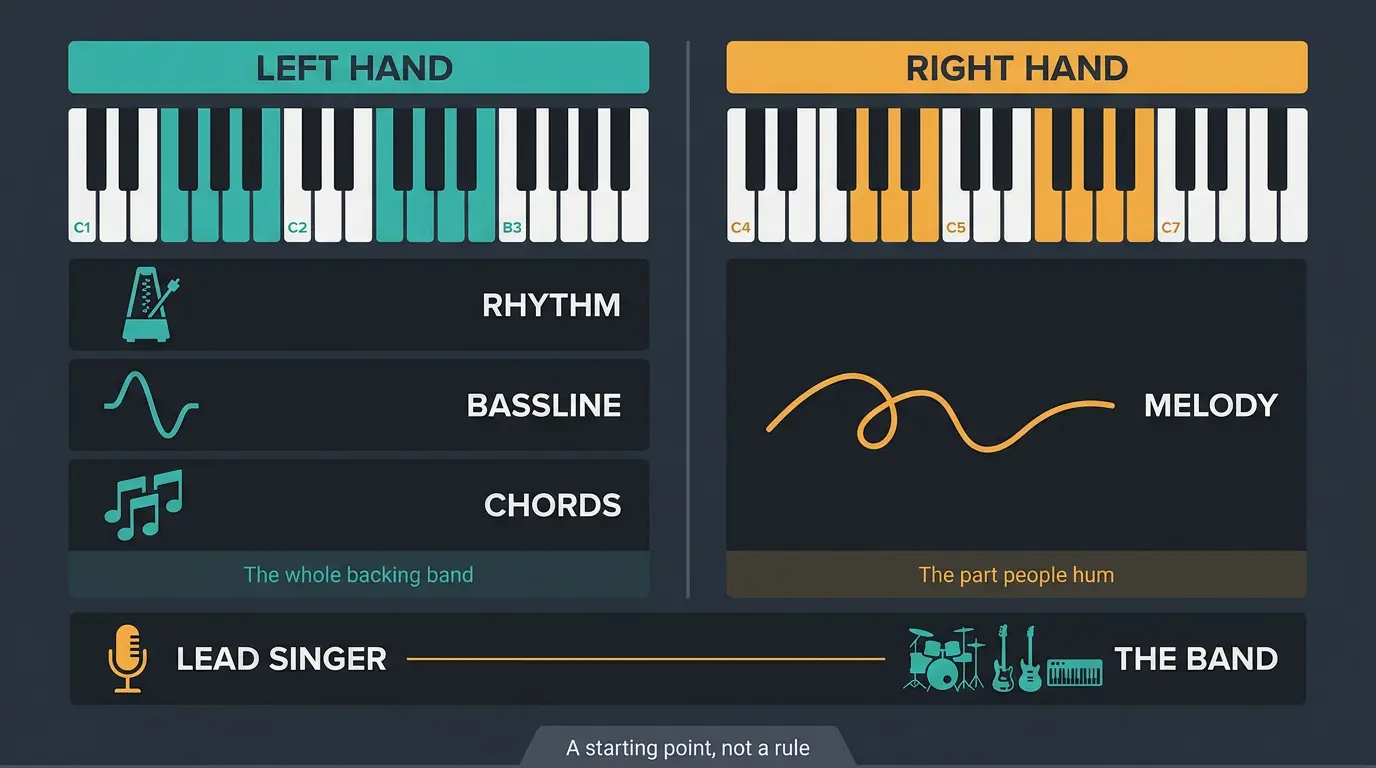
The default setup is simple. Your right hand carries the melody — the part people hum on the way home. Your left hand plays the part of the whole backing band: the rhythm, the bassline, and the chords that hold the harmony together.
Think of the right hand as the lead singer and the left hand as the band behind them. That mental picture gets you playing fast, and it's a genuinely useful place to start.
But I want to be honest with you up front. This is a starting point, not a law. Plenty of great songs break this rule the second it gets in the way, and we'll get to why in a minute.
Building up the left hand step by step
Don't try to play a full, busy left-hand part on day one. Build it up in layers.
Start with just the root notes of each chord. If you're playing C, your left hand plays a single low C. That's it. The goal here is only to get both hands moving together without your brain melting.
Once that feels steady, add octaves — thumb and pinky playing the same note name. When your thumb hits C, your pinky grabs the C below it. Then, when that's comfortable, fill in the full chord.
From there you've got options for the actual pattern, depending on the feel you want:
- Bass-chord — a low bass note followed by the chord, a workhorse for 4/4 time.
- Waltz — bass note, then two chord hits, for 3/4 time.
- Arpeggios — rolling the chord notes one at a time, lovely for 6/8.
- Pedal bass — holding one low note or octave under a moving right hand for a few bars.
- Walking lines — simple stepwise moves like C-B-A-G-F to connect chords.
If you want to go deeper on the options here, this breakdown of left-hand piano patterns is a good reference. Make sure you practice hands separately first, then bring them together slowly. Balance matters far more than speed — get it clean at a crawl and the tempo comes on its own.
The myth that the left hand is just background
Here's the misconception I want to clear up: the idea that the left hand is the unimportant one, just filler under the melody.
It's not. Your two hands aren't really two separate instruments — they're one instrument working together to play all the notes a song needs. The left hand can lead. The melody can live down in the bass.
Case in point: "Another One Bites the Dust." John Deacon wrote that bassline first, and the whole song grew around it. If he'd locked himself into "left equals chords, right equals melody," that song might not exist. So don't box yourself in. Whatever hand the idea shows up in, follow it.
Chords first or melody first?
There's no correct order here. Both work. Pick whichever one gets you unstuck and jumpstarts the writing.
The case for melody first: it keeps your tunes from getting trapped. You can usually tell a song that started with chords — the melody tends to hover around one or two notes while the chords shift underneath it. Starting with the melody makes you more likely to reach for leaps, a big high point, and a real use of your range.
The case for chords first: it's completely valid, and cycling through a progression is a great way to spark ideas out of thin air. Loads of writers work this way.
In practice the two are rarely fully separate. A good melody already implies the chords that'll support it — the moment you hear a tune in your head, you're also hearing where the harmony wants to move. My honest recommendation is a hybrid: sketch a melody over a very basic progression. If you want to work in the other direction, finding chords for a melody has its own approach worth knowing.
The best keys and progressions to start with
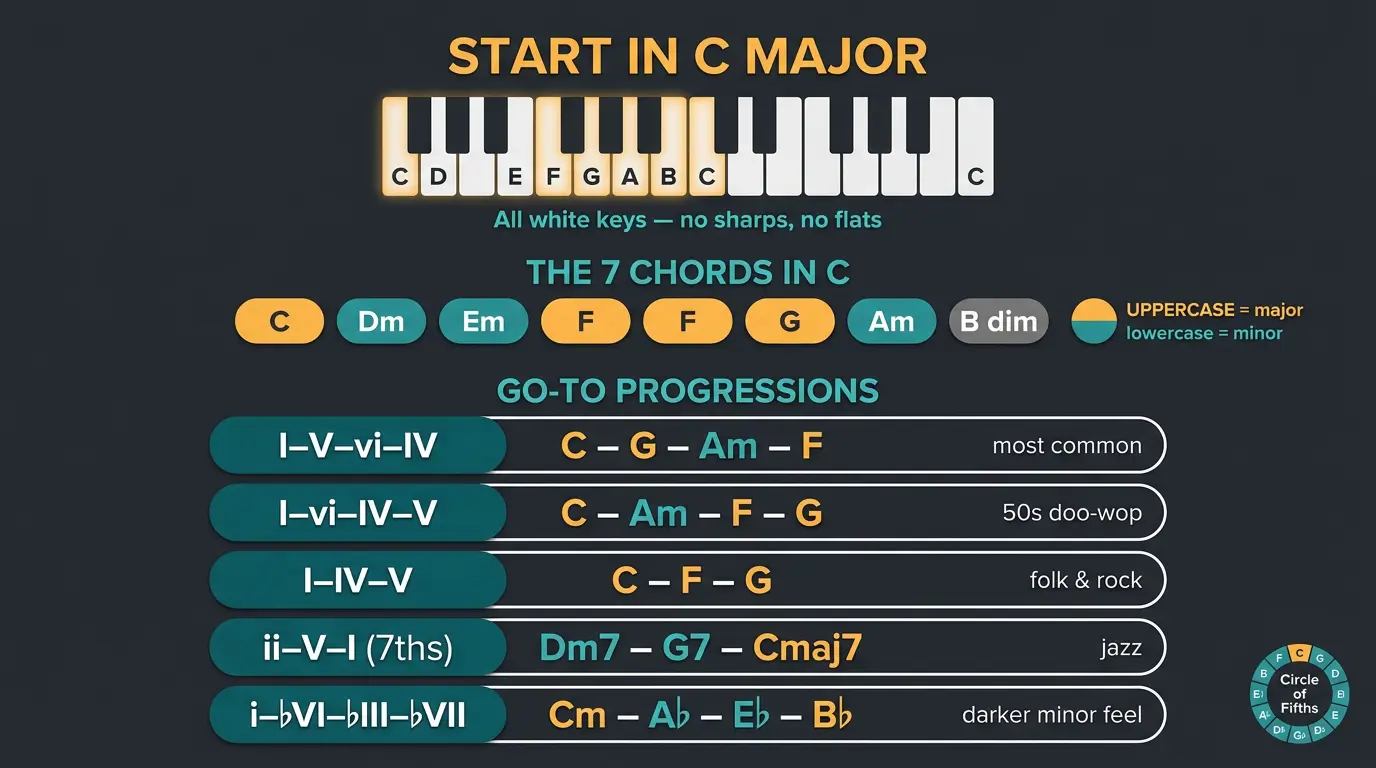
Start in C major. No sharps, no flats, and the shapes sit simply under your hands. All white keys, which is one less thing to think about while you're chasing an idea.
The seven chords built from C major are: C, Dm, Em, F, G, Am, and B diminished. Upper case means major, lower case means minor. A minor is the relative minor of C — same white keys, different home base. If you want the full tour, we broke down the chords in the key of C in its own post.
Here are the go-to progressions, all shown in C:
- I–V–vi–IV (C–G–Am–F) — the most common progression you'll ever meet. Loops forever without feeling stuck.
- I–vi–IV–V (C–Am–F–G) — the classic '50s doo-wop move.
- I–IV–V (C–F–G) — folk, rock, and about a million other songs.
- ii–V–I as sevenths (Dm7–G7–Cmaj7) — the backbone of jazz.
- i–♭VI–♭III–♭VII — a minor-key option with an epic, darker feel.
The Circle of Fifths is a handy starting tool here — chords sitting next to each other on it tend to sound good together. And don't worry about reusing common progressions. They're not a crutch; they're a skeleton you build your own song on top of.
Why voicings matter more on piano than guitar
This is where piano pulls ahead of guitar-based songwriting advice. On piano, you can voice the same chord dozens of ways without changing what it does in the progression.
Take a C major chord. In root position, C is on the bottom. Put E on the bottom instead and you've got first inversion. Put G on the bottom and it's second inversion. The progression is identical — but the texture and feel change completely.
So sequence it smart. Learn your progressions in C in plain root position first, until the harmony is sitting in your ears and your hands. Then start swapping in inversions and see what opens up. That's the fun part, and it's the thing that makes your version of a common progression sound like nobody else's.
A simple start-to-finish workflow
- Pick a key — C major is the easiest to write in, no sharps or flats to trip over.
- Grab a common progression like I–V–vi–IV (C–G–Am–F) as your foundation.
- Sketch a melody over it with your right hand, aiming for leaps and a high point instead of one repeated note.
- Build up the left hand in layers: root notes first, then octaves, then full chords or a pattern that fits the feel.
- Experiment with inversions and voicings once it's solid, and swap the hand roles around if it serves the song.
Frequently Asked Questions (FAQs)
Do I need to know music theory to write a song on piano?
No, you don't need theory to write a song on piano. Plenty of great songs came from people who couldn't name a single chord. That said, a little theory — like knowing the chords in a key — makes the whole thing faster and less like guessing in the dark.
What's the easiest key to write in on piano?
C major is the easiest key to write in. It has no sharps or flats, so you're playing all white keys, and the chord shapes are simple under both hands. Get comfortable there first, then move to other keys once the ideas come easily.
Should I write the melody or the chords first?
Either works — write whichever comes to you first. Melody-first tends to give you more interesting, wider-ranging tunes, while chords-first is great for sparking ideas. Most people land somewhere in the middle, sketching a melody over a basic progression.
Can I write a song with just chords and no melody?
Yes, you can write a song with just chords, and instrumental and ambient pieces do it all the time. For most vocal songs, though, the melody is what people remember and hum. If you're writing something to be sung, you'll want a melody eventually.
Why do my melodies sound stuck on one note?
Melodies get stuck on one note usually because you wrote the chords first, so the tune just hovers while the harmony moves underneath. Try writing the melody on its own first, and push yourself toward leaps and a clear high point instead of staying on the same pitch.
Final Thoughts
Writing on piano isn't magic. It's a melody in one hand, some chords and a bassline in the other, and a willingness to break your own rules the moment a better idea shows up. Start in C, grab a progression, and let your ears lead.
Less is more here — a simple song played with feeling beats a complicated one every time. Sit down, play something plain, and build from there. You'll be surprised how far a few white keys can take you.
Some of the links within this article are affiliate links. These links are from various companies such as Amazon. This means if you click on any of these links and purchase the item or service, I will receive an affiliate commission. This is at no cost to you and the money gets invested back into Audio Sorcerer LLC.