Reverb and delay both mess with time, and people confuse them constantly. Here's the core distinction, fast: reverb is a wash of blended reflections, delay is a set of distinct repeats. That's it. Everything else is detail.
Think about clapping your hands. In an empty gym, the sound smears out into one big tail that fades slowly — that's reverb. In a carpeted bedroom, you get a couple of short, separate slaps back and then nothing — that's closer to delay. Same idea, different behavior.
Here's the fun part: they're technically related. Algorithmic reverb is built from delay lines stacked on top of each other until the repeats blur into a smooth tail. So reverb is, in a sense, a very busy delay. That's a neat bit of trivia, but I promise to keep this useful instead of academic. Let's get into it.
TABLE OF CONTENTS
What reverb actually does
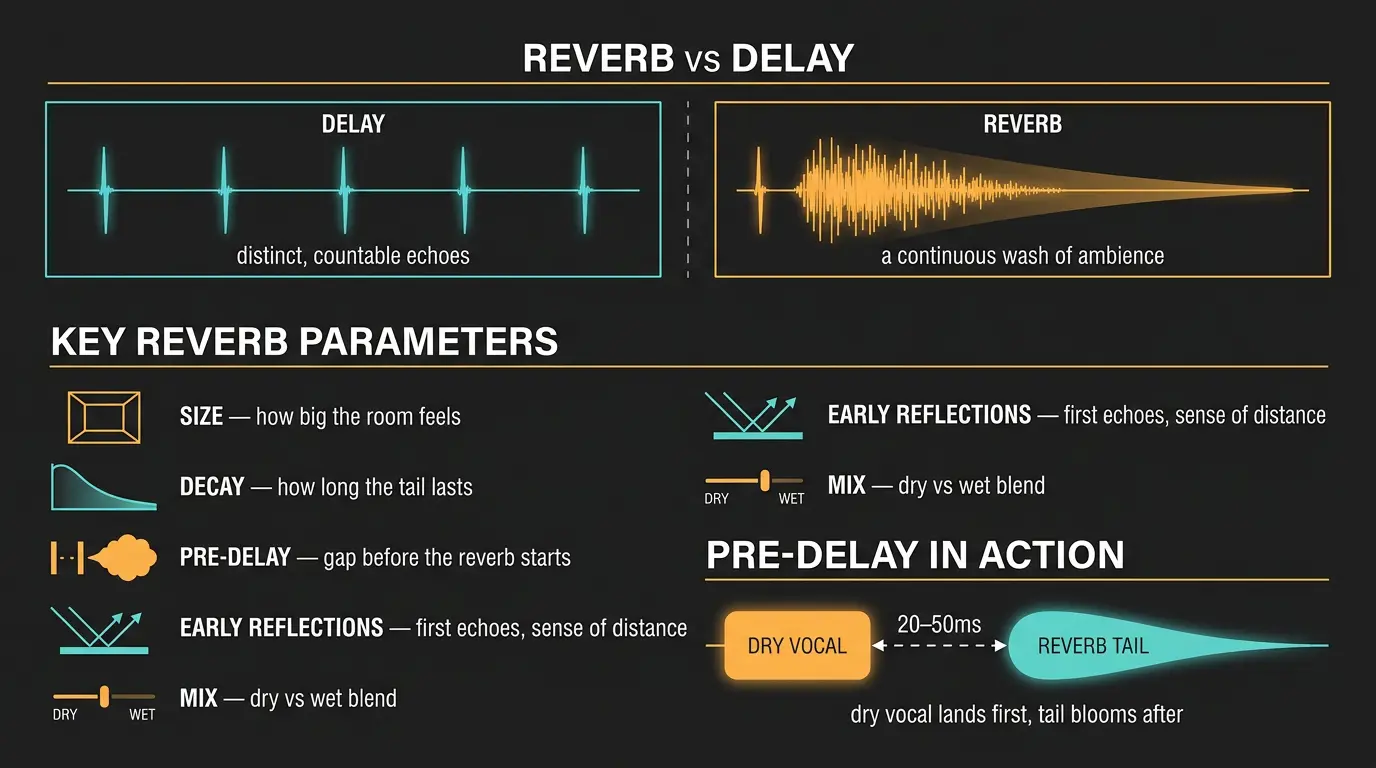
Reverb simulates a space by layering thousands of tiny reflections that blend into a smooth tail. Where delay gives you distinct, countable echoes, reverb gives you a wash — the individual reflections happen so fast and so densely that your ear reads them as one continuous ambience.
A few parameters run the show, and you don't need a manual to get them:
- Size — how big the simulated room feels.
- Decay — how long the tail lasts. Long decay for lush and expansive, short for subtle space.
- Pre-delay — the gap between the dry sound and the start of the reverb. This one's underrated.
- Early reflections — the first echoes off the walls, which define how close or far the source feels.
- Mix — how much wet signal you're blending in.
Here's a practical one: a plate reverb with 20 to 50ms of pre-delay keeps a vocal upfront while still adding polish. That little gap lets the dry vocal land first before the tail blooms behind it. If you want to go deeper, we've got a whole guide on dialing in reverb pre-delay.
The reverb types worth knowing
Some reverbs recreate real physical spaces. Others recreate man-made devices. Here are the ones worth having in your back pocket:
- Room — the smallest and most natural. Short tail, quick reflections. Great for a sense of "this was recorded somewhere real."
- Hall — long decay, big and luscious, like a concert hall. Lovely on strings and ballad vocals.
- Chamber — sits between room and hall. Dense but clearer than a hall, and it flatters vocals. Capitol Studios still runs concrete chambers under the building.
- Plate — a mechanical device, not a real space. Bright and smooth with no obvious early reflections. A classic on vocals and snare.
- Spring — the signal runs down a literal coiled spring. Bright, bouncy, a little boingy. Perfect for surf guitar, dub, and garage rock.
Then there are the modern staples the classic five leave out: convolution (more on that next), shimmer (a synthetic pitched wash that soars), and gated or non-linear reverb (the tail gets chopped off abruptly — think '80s drums). If you want to nerd out on a couple of these, we've got dedicated pieces on plate reverb and spring reverb.
Convolution vs algorithmic reverb
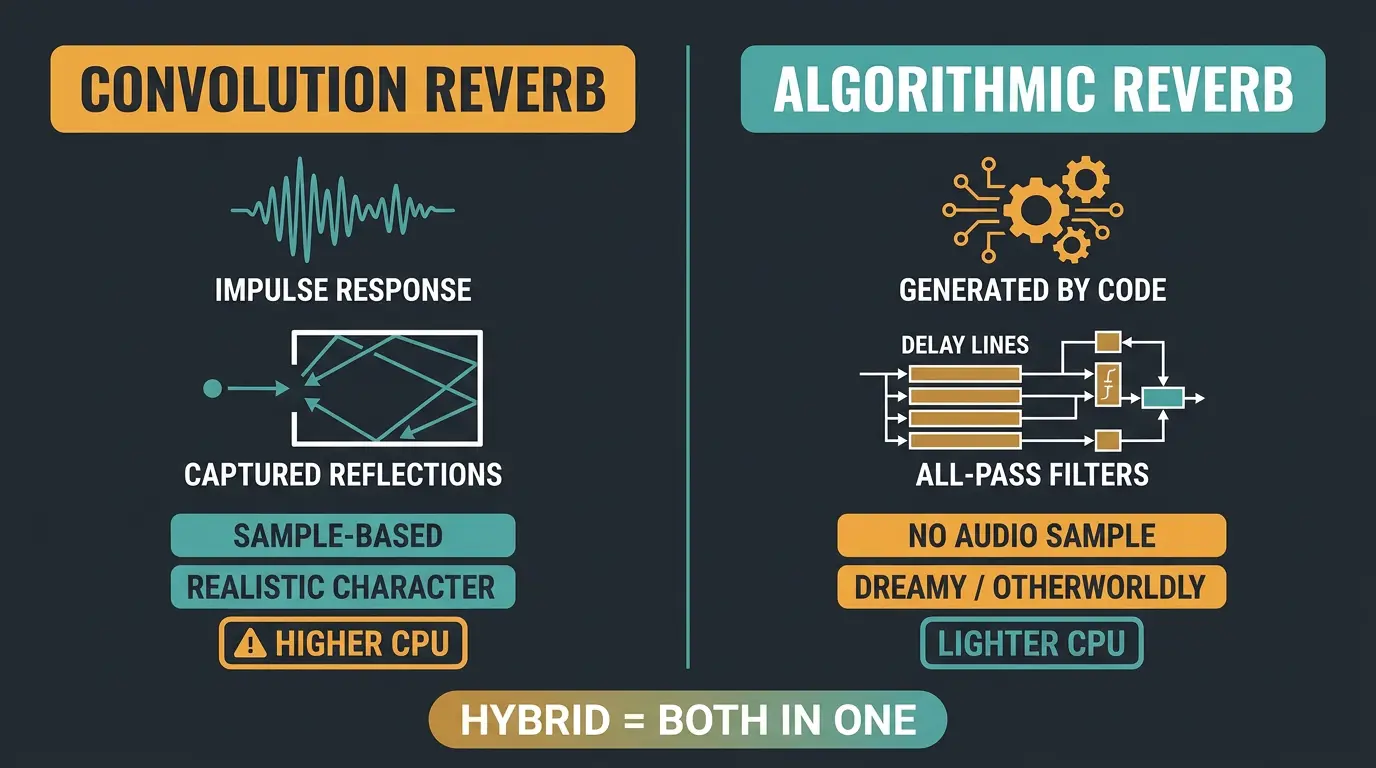
These are the two ways reverb gets made, and the difference matters. Convolution uses an impulse response — a recording of how a real space reacts to a quick, sharp sound. You capture all the echoes and reflections bouncing back, and the plugin uses that fingerprint to drape your signal in that exact room.
Algorithmic reverb uses no audio sample at all. It generates ambience purely from code — delay lines, all-pass filters, and math working together to fake a space.
The character tends to split like this: convolution leans toward realism, algorithmic leans toward a dreamy, otherworldly quality. There's a tradeoff, too — convolution is sample-based, so it eats more CPU, especially with long impulse responses and high sample rates.
Neither one is better. They're just different, and plenty of engineers combine them. Ableton's Hybrid Reverb is basically both in one box — algorithmic engines you can pair with an impulse response. If you want the deep dive, we wrote a whole piece on how convolution reverb works.
What delay actually does
Delay records your input and plays it back after a set amount of time, creating distinct repeats. Those repeats are measured in milliseconds or synced to your project tempo. Simple concept, huge range of uses.
Three controls do the heavy lifting:
- Delay time — how long before the first repeat, in ms or note values.
- Feedback — how many repeats you get. Low for one or two, high for a long trailing echo.
- Mix — the dry-to-wet balance.
The concept that ties it all together is tempo sync. In-time delays reinforce the groove and sit inside the track. Out-of-time delays pull attention toward the effect instead of the playing — sometimes that's what you want, often it isn't. The most recognizable rhythmic example is the dotted-eighth delay, where the repeat lands between the beats and gives you that propulsive, U2-style guitar feel.
The delay types worth knowing
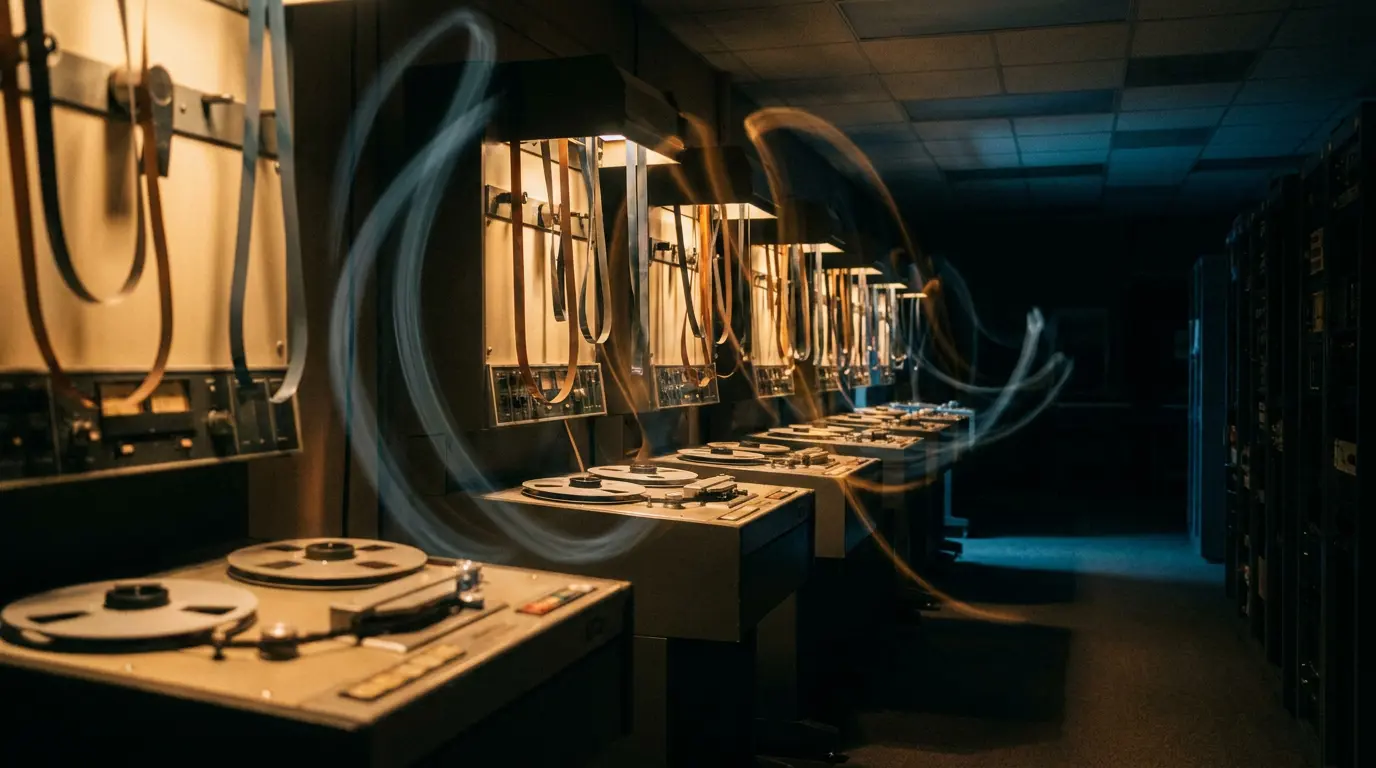
Delay is a much richer category than "digital echo," so let's give the types their due:
- Slapback — a single short echo, roughly 75 to 100ms. Instant retro on vocals and guitars.
- Ping-pong — the repeats bounce across the stereo field, left to right.
- Tape delay — warm and slightly distorted, modeled after old tape machines. Musical imperfection.
- BBD / analog — bucket-brigade circuits with a darker, degrading repeat.
- Multi-tap — several independent delay lines, each with its own time, level, pan, and filtering.
- Dub delay — less a setting than a whole vibe: tape echo cranked with heavy feedback for those psychedelic '70s soundscapes.
Here's the thing about tape, BBD, and digital — they've all endured on their own merits, which is exactly why there are so many plugin emulations of each. None of them "won." If you want to go properly down the rabbit hole, Attack Magazine's ultimate delay guide covers the territory in depth.
How to choose — and how to use both together
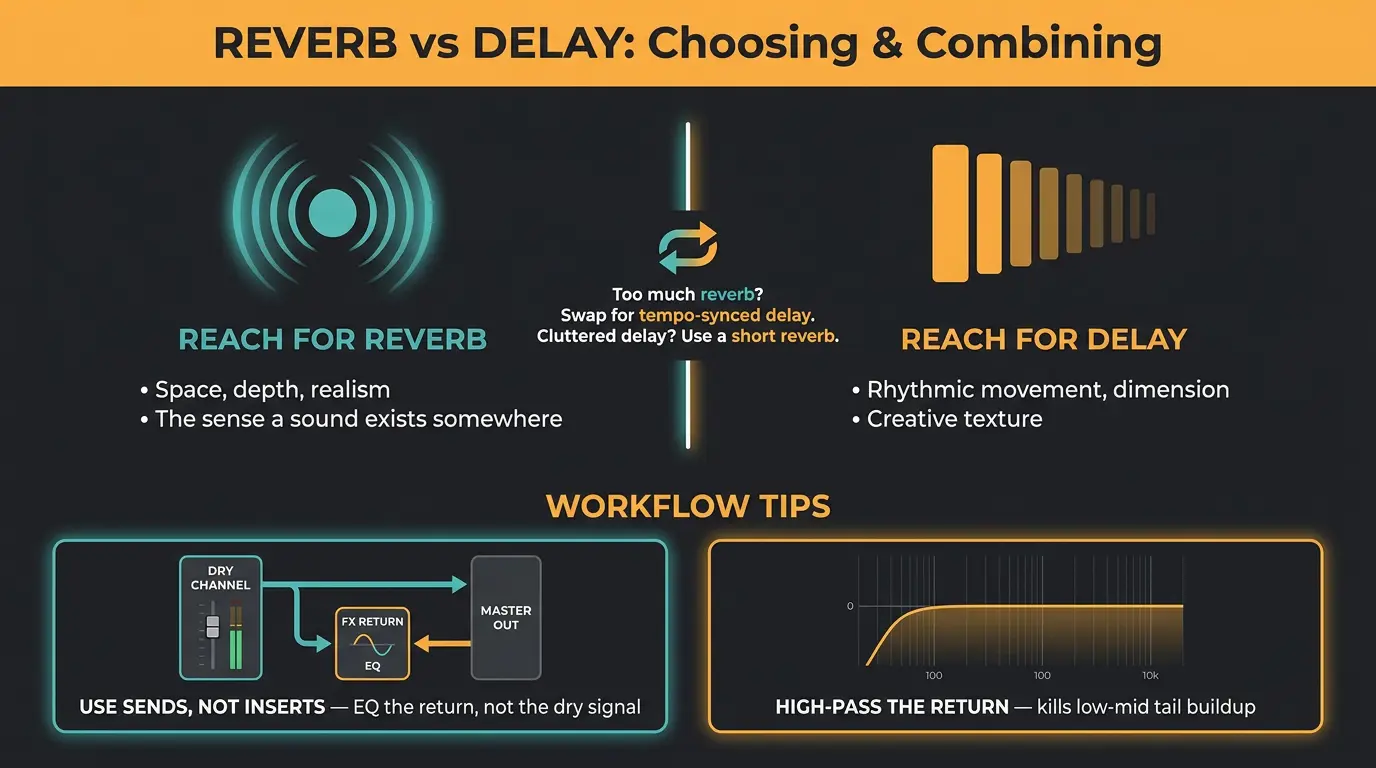
Reach for reverb when you want space, depth, and realism — the sense that a sound exists somewhere. Reach for delay when you want rhythmic movement, dimension, or creative texture. That's the quick decision tree.
If you're starting out, use reverb for general space first, then add delay for specific rhythmic effects on top. Don't try to do everything with one effect.
Here's the clarity point most people miss: delay is often cleaner than reverb. A ton of producers over-reverb and end up with mud. If your reverb is washing out a vocal, swap some of it for a tempo-synced delay — you'll keep the sense of space without the buildup. And it works the other way too. If delay is cluttering the mix, a short reverb can do the job more smoothly. Less is more applies hard here.
Two workflow tips that'll save you every time:
- Run both as sends, not inserts. On a send you can EQ the effect return without touching the dry signal.
- High-pass the return. Reverb and delay tails pile up low-mid energy fast, and a high-pass filter on the return kills that buildup before it destroys your mix.
Quick reference: reverb vs delay
- Reverb is a wash of blended reflections that creates space and depth.
- Delay is a set of distinct repeats that creates rhythm and movement.
- Start with reverb for general space, then add delay for specific rhythmic effects.
- If the mix is getting muddy, swap one effect for the other — delay is usually the cleaner of the two.
Frequently Asked Questions (FAQs)
Is reverb a type of delay?
Technically, yes — algorithmic reverb is built from stacked delay lines that repeat so densely the echoes blur into a smooth tail. So reverb is essentially a very busy delay. In practice, though, you treat them as separate tools because they do different jobs in a mix.
Can you use reverb and delay at the same time?
Absolutely, and most pro mixes do. Reverb handles the sense of space while delay adds rhythmic movement. Just run both on sends rather than inserts, and high-pass each return so the tails don't pile up and muddy your low mids.
Which one muddies a mix more, reverb or delay?
Reverb muddies a mix faster than delay because its dense, continuous tail fills up space constantly. Delay's distinct repeats leave gaps, so it usually stays cleaner. If reverb is washing things out, try swapping some of it for a tempo-synced delay.
What's the difference between convolution and algorithmic reverb?
Convolution reverb uses an impulse response — a recording of a real space's reflections — to recreate that exact room. Algorithmic reverb generates ambience purely from code, no audio sample involved. Convolution leans realistic and uses more CPU; algorithmic leans dreamy and runs lighter.
Should delay go before or after reverb in the chain?
Delay usually goes before reverb, so the reverb smooths out and blends the delay's repeats into the space. Reverb after delay sounds natural and cohesive. Flip the order if you want a more distinct, echoing effect on top of the ambience — trust your ears.
Final Thoughts
Reverb and delay aren't rivals — they're two tools that solve different problems. Reverb gives you a place for a sound to live. Delay gives it movement and rhythm. Once that clicks, choosing between them stops feeling like a coin flip.
Make sure you use them on sends, high-pass the returns, and reach for less than you think you need. Your mix will thank you, and so will whoever's mastering it.
Some of the links within this article are affiliate links. These links are from various companies such as Amazon. This means if you click on any of these links and purchase the item or service, I will receive an affiliate commission. This is at no cost to you and the money gets invested back into Audio Sorcerer LLC.