A polar pattern is just how a mic responds to sound coming from different directions. That's it. Some patterns hear everything around them, some focus on what's in front and ignore the rest, and a few do something in between.
Picking the right one matters more than most people think. The wrong pattern can drag your room into a vocal take you wanted dry, or leave you fighting feedback all night at a gig.
Here we'll walk through each pattern in plain English, bust one myth that gets passed around constantly (spoiler: patterns aren't the neat shapes on the graph), and get into the newer switchable and adjust-in-post mics that change how you think about the whole choice.
TABLE OF CONTENTS
The three families every pattern comes from
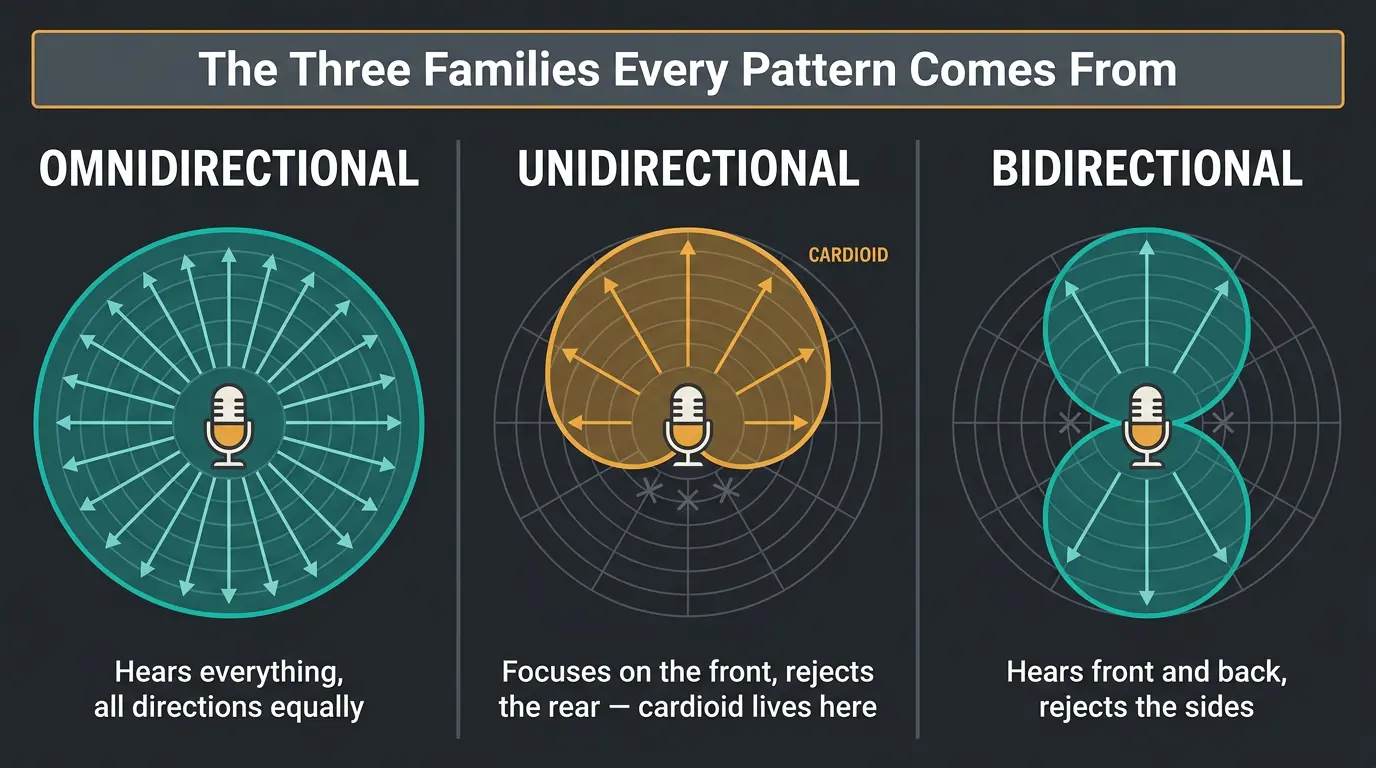
Before the names get confusing, know that every polar pattern is a variation of one of three parent types. Get these three and the rest falls into place.
- Omnidirectional — hears everything, all directions equally.
- Unidirectional — focuses on the front and rejects the rear. Cardioid and its cousins live here.
- Bidirectional — hears the front and back, rejects the sides.
Cardioid is the one you've probably used a hundred times without thinking about it. It's the most common unidirectional pattern, which is why people treat "cardioid" and "microphone" as basically the same thing. They're not, and knowing the difference opens up a lot of options.
The thing nobody tells you: polar patterns aren't fixed
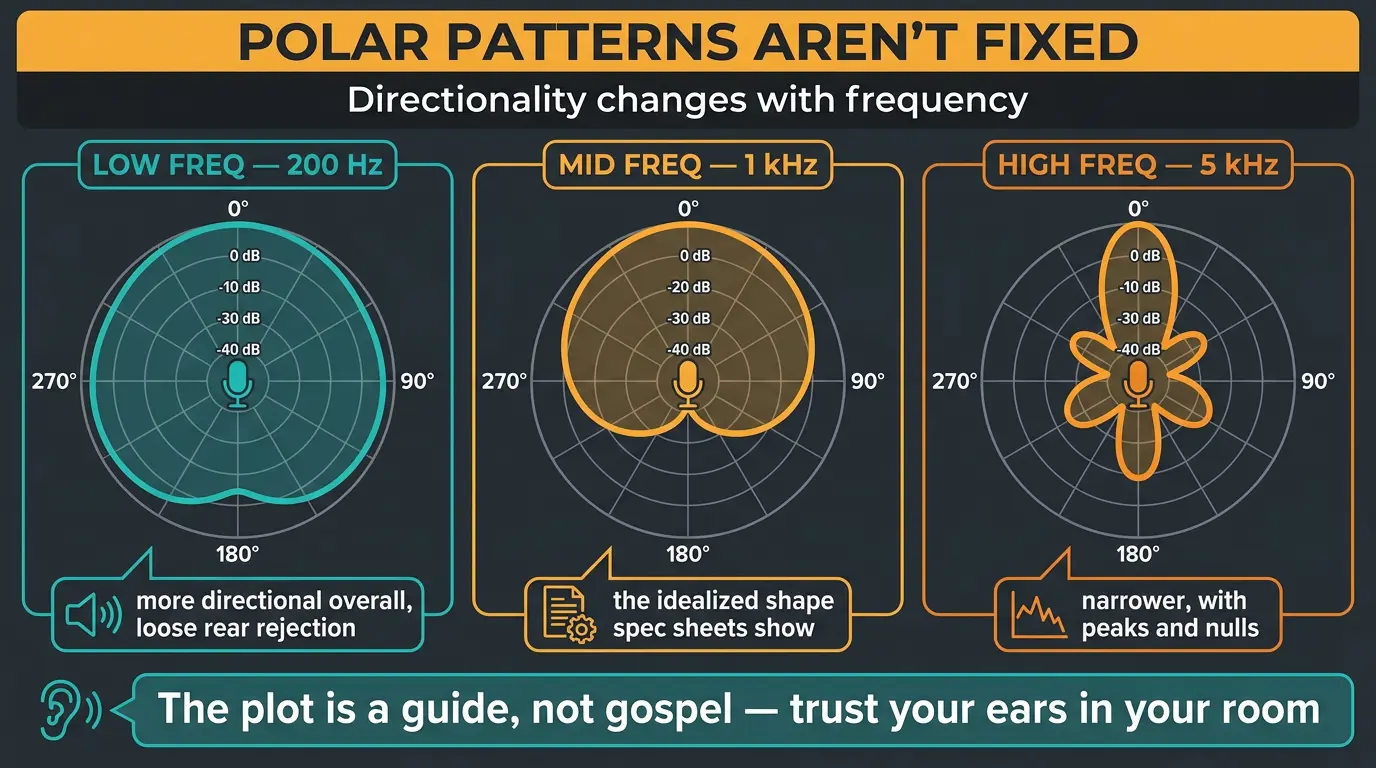
Here's the part that changes how you read every spec sheet. The clean, symmetrical polar plot printed on a manufacturer's page is a smoothed, idealized picture. The real behavior is messier.
Directionality is frequency-dependent. Nearly every mic gets more directional at low frequencies and less directional at high ones. A "cardioid" mic doesn't reject the rear the same way at 200Hz as it does at 5kHz — there are peaks and nulls at various frequencies that the tidy graph just doesn't show.
Why does this matter for you? It's why off-axis sound often sounds dull or colored instead of simply quieter. That drummer bleeding into your vocal mic from behind isn't just softer — it's a weird, filtered version of itself.
Make sure you treat the polar plot as a general guide, not gospel. The real test is your ears in your room with your source. Move the mic, listen to what leaks in, and trust what you hear over what the diagram promised.
Walking through each pattern
All right, cool. Now that you know the shapes aren't perfect and the three families they come from, let's go through the individual patterns and where each one actually earns its keep.
Omnidirectional
An omni mic is equally sensitive to sound from every direction, so its pickup forms a sphere around the capsule. It generally gives you a flat frequency response and a natural, open sound that includes the room around it.
Here's the practical win people forget: omni has the lowest self-noise of any pattern. Because it isn't using pressure-gradient tricks to reject the rear, it stays quiet and clean.
A scenario where omni shines is a well-treated room where you actually want the ambience — a room mic on drums, an acoustic source you want to breathe, or a vocal in a space that sounds great. In a bad-sounding room, that same openness works against you, so read the space first.
Cardioid, supercardioid, and hypercardioid
Cardioid is the workhorse. It's heart-shaped, focused on the front, and rejects the rear at roughly -20dB — meaning sound from directly behind comes in at about one-tenth the sensitivity of sound in front. That's why it's the go-to for isolating a source in the studio and on stage. If you've read our breakdown of dynamic vs condenser mics, most of the usual suspects there are cardioid.
Supercardioid and hypercardioid tighten the front pickup even more and reject the sides harder — around -10dB at 90° and 270° for super, and about -12dB for hyper. The trade-off is a small rear lobe, meaning they start picking up a little from directly behind again.
In live sound this matters a lot. That tighter front and stronger side rejection buys you more gain before feedback and keeps the signal drier. Just remember the rear lobe when you're placing wedges — point that null where the monitor is, not the tighter front.
Bidirectional (figure-8)
A figure-8 mic picks up the front and back equally and fully rejects the sides. Sound hitting the capsule at 90° and 270° pushes on both faces of the diaphragm equally, which cancels out — a true null.
That makes it perfect for two people facing each other: a duet, an interview, or two vocalists sharing one mic. It's also half of the classic Mid-Side stereo setup, where a figure-8 handles the width. Small pattern, big usefulness.
Shotgun (lobar) — more complicated than 'the tightest pattern'
Shotgun mics get described as "the tightest pattern," and that's an oversimplification worth correcting. They're really hybrids. Most high-performance shotguns behave as a line mic at high frequencies and as a plain super- or hypercardioid below a certain point — usually under about 2kHz for a standard-length tube.
The magic is the interference tube in front of the capsule. On-axis sound travels straight down the tube unimpeded, while off-axis sound enters the side slots at different path lengths, arrives out of phase, and partially cancels itself. That's what narrows the front pickup beyond what a hypercardioid alone can do.
Tube length sets the limit. The longer the tube, the lower the frequency it can still control — which is why the big boom mics are long. Worth knowing too: the "true" lobar pattern is mostly theoretical. Most real shotguns have front and rear lobes, and only a handful hit the textbook shape. If you're shopping, our roundup of the best shotgun mics gets into specific models.
Subcardioid and boundary mics
Two more that round out the classic six. Subcardioid — sometimes called wide cardioid — sits between omni and cardioid. It's wider and more ambient than cardioid but still leans toward the front, with a smooth off-axis tone that flatters a good room.
Boundary mics, like PZMs, are their own category. They mount flush against a surface — a floor, a table, a wall — and use that surface as part of the pickup, which sidesteps a lot of phase problems. Handy for conference tables, stages, and capturing a whole room from one plane.
| Pattern | Rear/Side Rejection | Best For |
|---|---|---|
| Omnidirectional | None — equal all around | Room mics, natural sources, treated rooms, lowest self-noise |
| Subcardioid | Mild front bias | Ambient capture with a little focus, good-sounding rooms |
| Cardioid | ~-20dB at rear | General studio and live isolation, the everyday workhorse |
| Supercardioid | ~-10dB at 90°/270°, small rear lobe | Live vocals, more gain before feedback, dry signal |
| Hypercardioid | ~-12dB at 90°/270°, small rear lobe | Tight isolation, noisy stages, close-miking in bleed |
| Bidirectional (fig-8) | Full side null, front and back equal | Duets, interviews, Mid-Side stereo |
| Shotgun (lobar) | Narrow front at HF, super/hyper at LF | Film, dialogue, distant sources, run-and-gun |
Switchable and adjust-in-post mics
You don't always have to commit to one pattern anymore. Multi-pattern condensers pack several pickup options into one body — usually three (cardioid, omni, figure-8), sometimes more. The AKG C414 XLII is the flagship, offering nine selectable patterns, including intermediate steps between the usual ones. Some designs even go infinitely variable.
Then there's the newer trick: adjusting the pattern after you record. Dual-output and modeling mics like the Townsend Sphere, Austrian Audio OC818, Antelope Edge, and the Slate VMS system let you dial in the pattern before tracking — and change it in the mix. Record now, decide later.
Now, the honest part. Engineers debate how "real" this is. With true dual-diaphragm mics that capture both capsules separately, adjusting the pattern in post is a genuine change to the pickup. With single-capsule modeling systems, some folks feel it behaves more like EQ than a true pattern shift. My take: both are useful, neither is magic, and the dual-output route gives you more honest flexibility. For further reading on how modeling mics work, this overview of microphone modeling plugins is a solid starting point.
Less is more still applies. A pile of switchable patterns won't fix a bad room or a bad mic position. Pick the pattern that solves an actual problem, then move on.
Frequently Asked Questions (FAQs)
What polar pattern is best for recording vocals?
Cardioid is the best all-around choice for recording vocals, since it focuses on the singer and rejects the room behind the mic. If your room sounds genuinely good, an omni or figure-8 can give a more open, natural tone. In a rough-sounding room, stick with cardioid for the isolation.
Do polar patterns really change with frequency?
Yes, polar patterns change with frequency on nearly every mic. Directionality tightens at low frequencies and loosens at high ones, so a cardioid rejects the rear differently at 200Hz than at 5kHz. The smooth graph on the spec sheet hides these peaks and nulls, which is why off-axis sound often sounds colored, not just quieter.
Is a shotgun mic just the tightest polar pattern?
No, a shotgun mic isn't simply the tightest pattern — it's a hybrid. It acts as a directional line mic at high frequencies but reverts to plain super- or hypercardioid below roughly 2kHz for standard tube lengths. The interference tube handles the highs, and a longer tube extends control to lower frequencies.
What's the difference between supercardioid and hypercardioid?
Hypercardioid has a tighter front pickup and stronger side rejection than supercardioid, at the cost of a slightly larger rear lobe. Supercardioid rejects the sides around -10dB at 90° and 270°, while hypercardioid hits about -12dB. Both give more gain before feedback than standard cardioid, so aim their null carefully on stage.
Are multi-pattern or post-adjustable mics worth it?
Multi-pattern and post-adjustable mics are worth it if you record varied sources and value flexibility in one body. Dual-diaphragm mics like the OC818 give genuine pattern control after tracking, while single-capsule modeling leans closer to EQ. They won't fix a bad room, but they're a real convenience for one-mic setups.
Final Thoughts
Polar patterns come down to a simple question: what do you want the mic to hear, and what do you want it to ignore? Learn the three families, remember that the graph is a smoothed guide rather than a promise, and you'll make better choices without overthinking it.
The gear keeps getting more flexible, but the fundamentals don't change. Pick the pattern that solves your actual problem, put the mic in a spot that sounds good, and let your ears settle the rest. There isn't always a right or wrong way here — just what works for the source in front of you.
Some of the links within this article are affiliate links. These links are from various companies such as Amazon. This means if you click on any of these links and purchase the item or service, I will receive an affiliate commission. This is at no cost to you and the money gets invested back into Audio Sorcerer LLC.