Binaural audio is how you fool your ears into hearing sound in 3D over a pair of headphones. Left, right, front, back, above your head — the whole space, from just two channels.
The term matters more than ever right now, because spatial audio is suddenly everywhere. It's baked into new phones, streaming services, and half the headphones on the shelf. And with all that attention, people mix the terms up constantly.
So here's the plan: what binaural actually is, how it works, and where it fits in the bigger picture. No filler.
TABLE OF CONTENTS
What binaural audio actually means
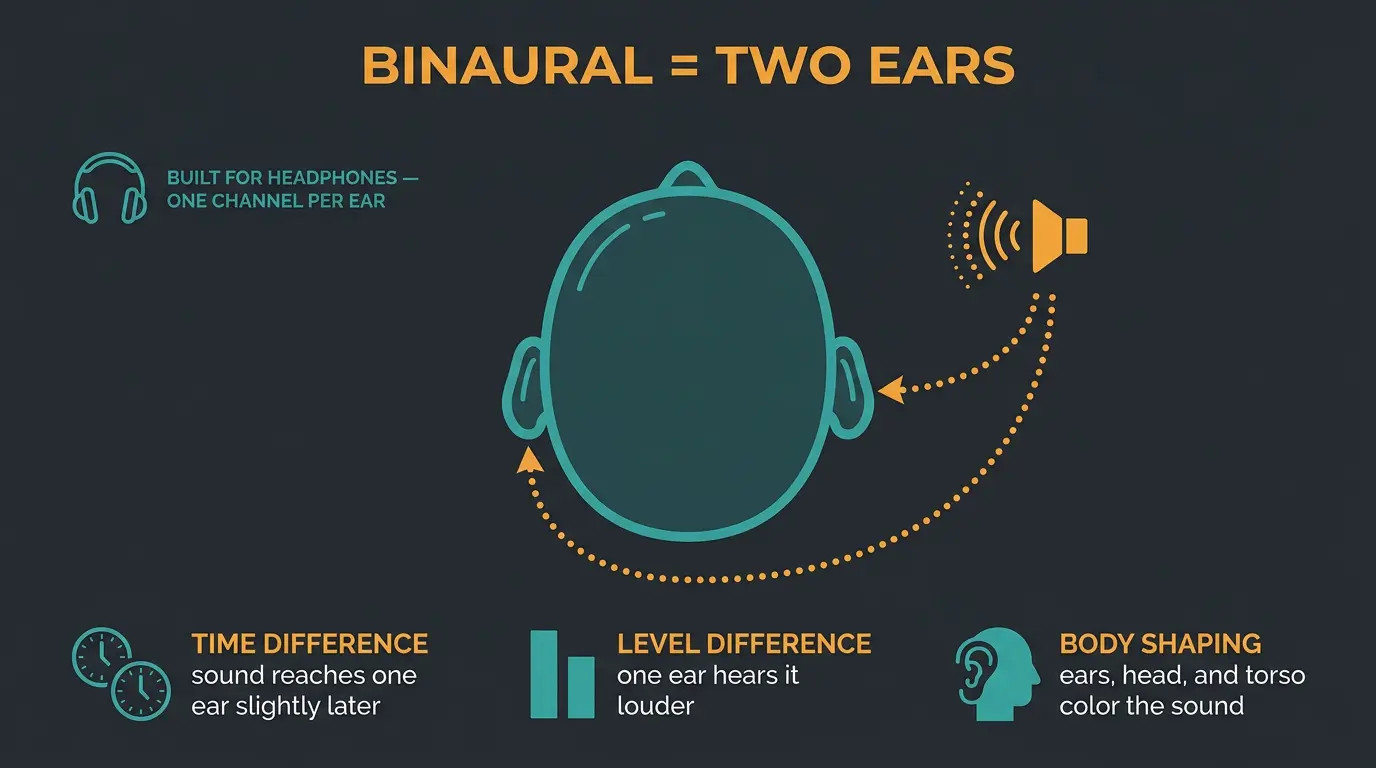
The word comes from "two ears," and that's the whole idea. Binaural audio is a two-channel format built specifically for headphones, where each channel feeds one ear.
Your brain figures out where a sound is coming from using a few cues. There's the tiny time difference between a sound hitting one ear versus the other. There's the level difference. And there's the way your outer ears, head, and torso shape the sound before it ever reaches your eardrums. Binaural audio recreates those cues over two channels, so your brain places the sound out in the world instead of stuck between your ears.
That definition covers two different approaches — capturing those cues with real microphones, or modeling them digitally. We'll split those apart in a second. And while it sounds like new tech, the core idea is over a century old.
A quick history, because it's older than you think
Back in 1881, French inventor Clément Ader set up paired microphones at the edge of the stage at the Opéra Garnier and piped the performance to listeners over two phone lines — one for each ear. It got dubbed the Théâtrophone, and it was one of the first binaural experiences on record.
Fast forward to Bell Labs, where researchers mounted a microphone to each cheek of a mannequin and called it "Oscar," the first binaural dummy head. Oscar showed up at the 1933 World's Fair in Chicago. The modern reference standard for this kind of recording is the Neumann KU series, and the KU-100 is still the dummy head engineers reach for today.
Two ways to make it: recording vs rendering
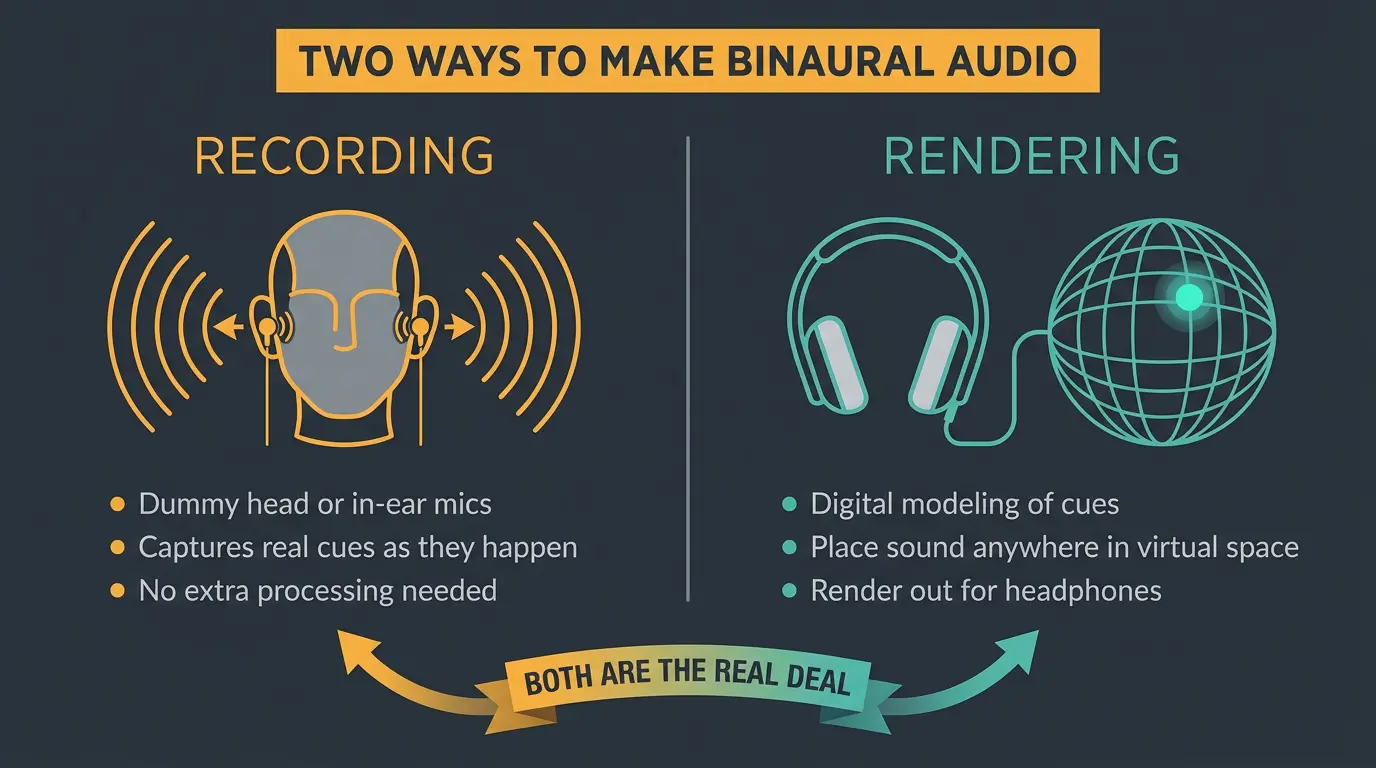
There are two legit ways to end up with a binaural track, and this is the part that's changed the most.
The first is recording. You use a dummy head like the Neumann, or tiny mics placed in someone's ear canals, and you capture the real localization cues as they happen. It's fast, it's cheap, and it needs no extra processing afterward. What the head hears is what you get.
The second is rendering. Instead of physical mics, you use digital modeling to recreate those same cues. That lets an engineer place a sound anywhere in a virtual space and render it out binaurally for headphones — no dummy head required. This is the big shift from the old-school definition, where binaural meant "a recording technique" and nothing else. Both approaches are the real deal. They just solve the problem from opposite ends.
HRTF: the math behind the magic
The engine behind the rendering side is the Head-Related Transfer Function, or HRTF. It's basically a model of how your ears, head, and torso change a sound depending on where it's coming from. Feed audio through that model and your brain reads it as "above and to the left" or "right behind me." This is closely related to the way our hearing responds unevenly across frequencies, which we get into in the Fletcher-Munson curve.
HRTF comes in two flavors: generic and personalized. A generic profile is one-size-fits-most and works fine for a lot of people. Personalized goes further — Apple scans your ears to build a custom profile, and Sony has you photograph both ears in its app. The data itself gets standardized in a format called SOFA, spec'd out as AES69.
Here's the honest part. No universal HRTF works perfectly for everyone, because everyone's ears and head are shaped differently. And in casual listening, plenty of people can't tell a personalized profile from a generic one. So try both if you can, and trust your own ears on it.
Head tracking and why it matters
Head tracking uses sensors in your headphones or phone to detect when you move your head, then anchors the sound to a fixed point in space. Turn your head to the right and you'll hear more of the sound shift into your left ear — exactly like it works in the real world.
Why does that matter? Because in real life, sound sources stay put when you move. When the audio moves with your head, part of your brain calls the bluff. Head tracking keeps the illusion honest, and it's a big reason modern spatial audio feels more convincing than the binaural demos of years past.
Where binaural fits under spatial audio
This is where most of the confusion lives, so let's sort it out.
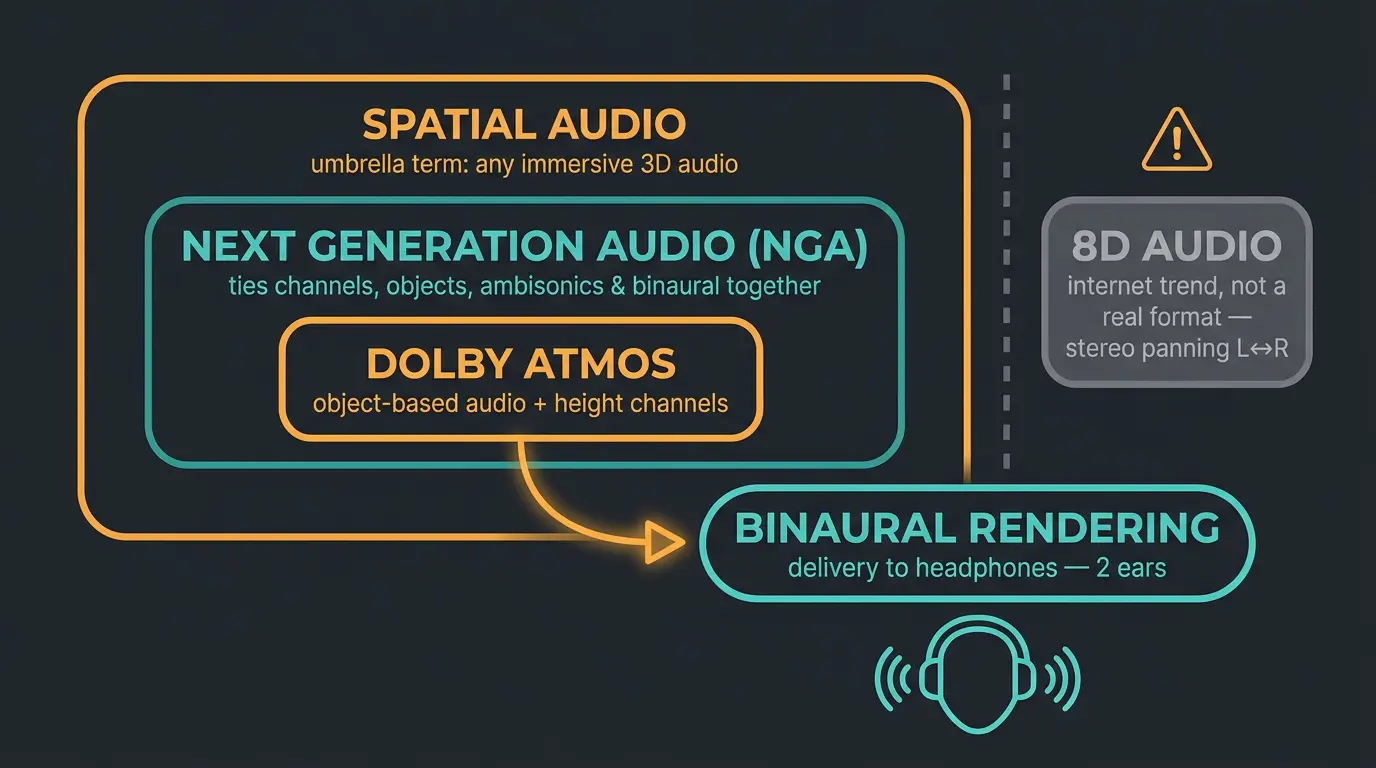
Spatial audio is the umbrella term. It covers any immersive 3D audio tech that puts sound around you. Dolby Atmos is a specific format that lives under that umbrella — it uses object-based audio with height channels, and it's one of the most popular implementations out there.
So where's binaural? On headphones, Atmos uses binaural rendering to actually deliver the effect to your ears. Binaural isn't competing with Atmos — it's the delivery mechanism that translates that big object-based mix into something two little speakers on your head can pull off. Zoom out further and you'll hear the term Next Generation Audio, or NGA, which is the broad category that ties channels, objects, ambisonics, and binaural together.
And then there's 8D audio, which you've probably seen on YouTube. Being honest here: it's an internet trend, not a real spatial format. It's stereo panning, reverb, and timing tricks that swing the sound left and right around your head. It can feel dramatic, but it's artificial and it's only ever moving side to side. If you want to read more on how mass-market spatial audio took off, The Broadcast Bridge has a solid overview.
Binaural vs spatial audio at a glance
- Spatial audio is the umbrella term for any immersive 3D audio that places sound around you.
- Binaural is the two-channel method that delivers that 3D effect specifically over headphones.
- Dolby Atmos is one format under the umbrella, and it uses binaural rendering for headphone playback.
The catch: it only works on headphones
Binaural is built for headphones, full stop. Play it over speakers and the whole thing falls apart, because of something called acoustic crosstalk — each ear ends up hearing both channels instead of one, and that scrambles the cues your brain was counting on. There's tech called crosstalk cancellation that tries to fix this for speakers, but it's finicky and situational. For everyday listening, keep it in headphones.
The other honest catch is format fragmentation. The same Dolby Atmos mix can sound different depending on who's rendering it — Apple uses its own renderer, Dolby uses another, and they don't interpret the mix identically. Platform support varies too. Some streaming services carry spatial content, some don't, and a few require a pre-rendered file to work on certain devices. None of this is a dealbreaker. It just means the experience isn't perfectly consistent everywhere yet.
Where binaural audio actually shines

Binaural used to get pitched as a VR-and-gaming thing, and it's genuinely great for both. But the sweet spots are wider than that now:
- VR and immersive gaming — where knowing exactly where a sound came from is half the experience.
- ASMR — the whole appeal is that up-close, all-around-your-head intimacy.
- Audiobooks and immersive theater — voices and scenes placed in real space pull you in.
- Experimental sound design — a playground for anyone who wants to move sound in three dimensions.
The bigger story is that binaural isn't niche anymore. It's a mass-market feature baked into most new phones and built into the major streaming services. Good headphones and treated rooms both help you hear this stuff clearly — if you're chasing an honest listening space, our rundown of acoustic panel options is a decent place to start.
Looking ahead, there's active work on AI that generates spatial audio from mono recordings or even from video. It's early, and I'm not going to oversell it. But the direction is real.
Frequently Asked Questions (FAQs)
Is binaural audio the same as spatial audio?
No. Spatial audio is the umbrella term for any immersive 3D audio, while binaural is the specific two-channel method that delivers that effect over headphones. Think of binaural as one of the tools spatial audio uses, not a separate competing thing. Formats like Dolby Atmos rely on binaural rendering for headphone playback.
Do I need special headphones for binaural audio?
No, any regular headphones or earbuds will play binaural audio, since it's just a two-channel format. You don't need anything special to hear the basic 3D effect. That said, headphones with head tracking and personalized HRTF profiles will make the illusion more convincing and stable as you move around.
Does binaural audio work over speakers?
No, binaural audio is designed for headphones and breaks down over speakers. The problem is acoustic crosstalk, where each ear hears both channels instead of just one, which scrambles the localization cues. There's crosstalk cancellation tech that tries to fix this, but for reliable results, stick to headphones.
Is 8D audio the same as binaural audio?
No, 8D audio is an internet trend, not a real spatial format. It uses stereo panning, reverb, and timing tricks to swing sound left and right around your head. It can feel dramatic, but it's artificial and only moves side to side. Binaural recreates actual localization cues for true 3D placement.
Is personalized HRTF worth it?
Sometimes, but it depends on your ears and how closely you're listening. A personalized HRTF profile can tighten up the 3D effect for some people, but plenty of listeners can't tell it apart from a generic profile in casual use. Try both if your gear supports it and trust your own ears.
Final Thoughts
Binaural audio isn't magic, even though it kind of feels like it the first time a sound lands behind you. It's a clever way of recreating the cues your brain already uses, delivered over two channels straight to your ears. Once you see it as the headphone delivery method sitting under the spatial audio umbrella, the whole landscape stops being confusing.
If you've got a decent pair of headphones, go put on a proper binaural track and give it a listen. That does more than any explanation I can write.
Some of the links within this article are affiliate links. These links are from various companies such as Amazon. This means if you click on any of these links and purchase the item or service, I will receive an affiliate commission. This is at no cost to you and the money gets invested back into Audio Sorcerer LLC.