The 12 bar blues is twelve measures in 4/4 time built on just three chords — the I, IV, and V of a key — that repeat as a loop. That's the whole thing. It's worth learning because it underpins a massive chunk of popular music, from old blues records to rock and roll to jazz, so once you've got it, you can hear it everywhere and play along with most of it.
TABLE OF CONTENTS
The 12 bar blues, bar by bar
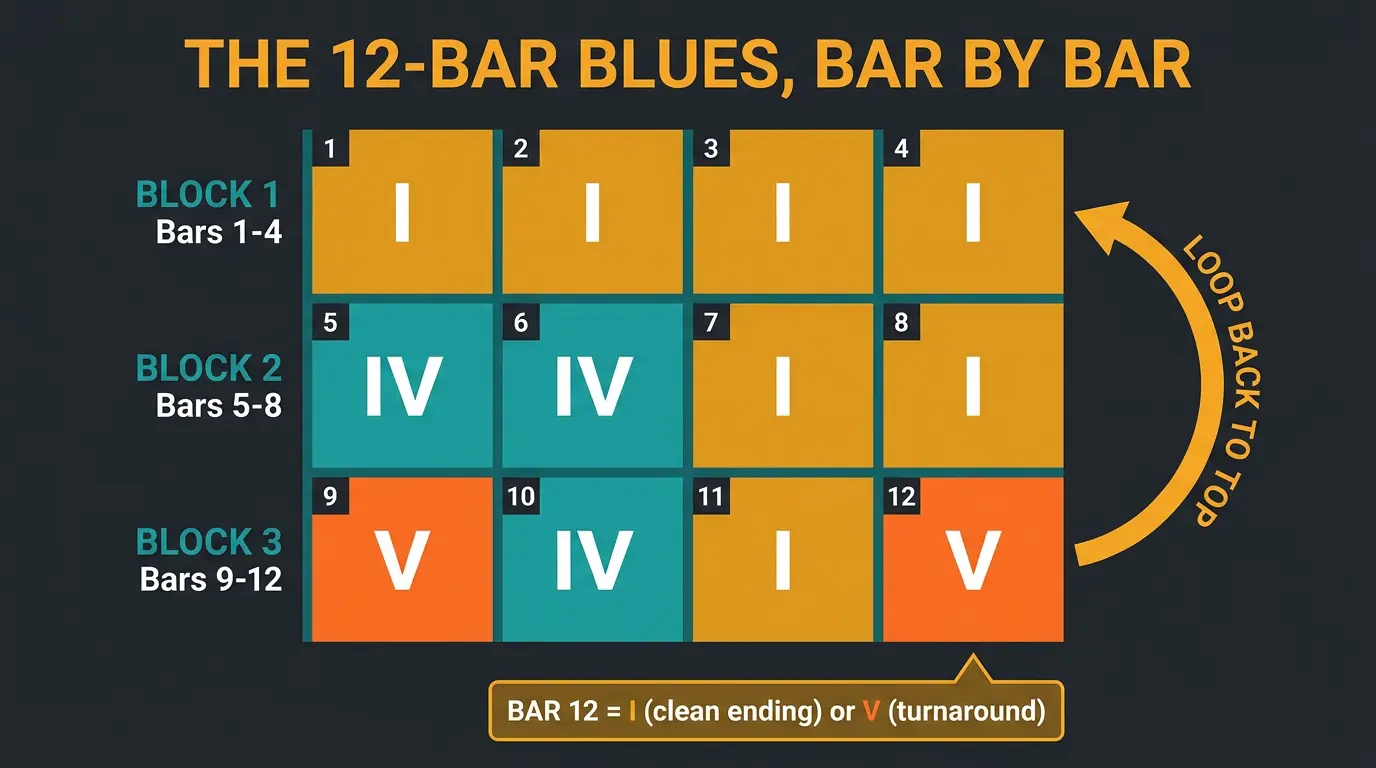
The cleanest way to think about it is three four-bar blocks. Each chord gets a full bar, and you just stack the blocks back to back.
- Block 1 (bars 1–4): I, I, I, I
- Block 2 (bars 5–8): IV, IV, I, I
- Block 3 (bars 9–12): V, IV, I, V
Then it loops back to the top and you do it again. That's the standard grid, and it's the one most folks mean when they say twelve-bar blues.
There's one spot worth flagging. Bar 12 is sometimes written as I (a clean ending) and sometimes as V (a turnaround that pulls you back to bar 1). Both are correct. The V version is the looping and jamming standard, since it sets up the next pass through the form. Use the I when you want the song to actually stop.
Why each block works
Block 1 sitting on the I chord for four bars is the call. There's no harmonic movement getting in your way, so you've got plenty of melodic room to set up the line.
Block 2 steps up to the subdominant IV, then comes home to the I. It's the variation — a little tension, then back to familiar ground. Block 3 is where it lands. The V pulls hardest, the IV walks back down, the I lands at home, and then bar 12 lifts back to V as the turnaround that throws you into the next loop.
If you know the AAB lyric form — two repeated lines and then a punchline — it maps right onto these three blocks. The shape of the words is the shape of the chords.
How to play it in any key
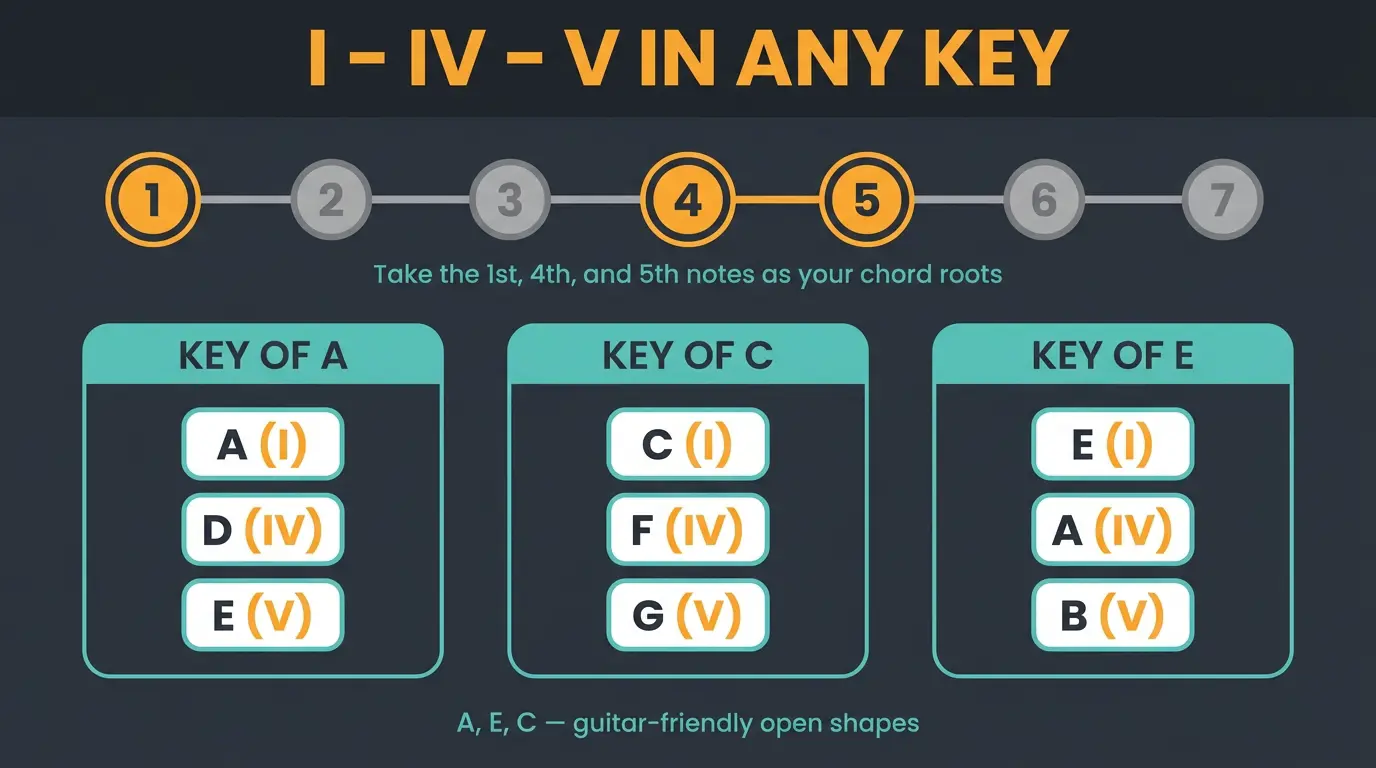
This is the part that makes it stick. The Roman numerals — I, IV, V — describe relationships to the key, not fixed chords. So the same shape transposes anywhere, which means you only have to learn it once.
The method is simple. Take the major scale of your key, then grab the 1st, 4th, and 5th notes as your chord roots. If counting scale steps trips you up, our breakdown of music scale degrees lays out exactly how those numbers work.
- Key of A: A (I), D (IV), E (V)
- Key of C: C (I), F (IV), G (V)
- Key of E: E (I), A (IV), B (V)
A, E, and C are the guitar-friendly favorites — the open shapes just fall under your fingers. Make sure you can find the I, IV, and V in a couple of keys without thinking too hard, because that's what lets you sit in with anyone. If you want more of these patterns, our guide to common chord progressions every songwriter should know is a good next stop.
The dominant 7th sound
Here's the detail that confuses a lot of people. Blues uses dominant 7th chords on all three chords — including the I. By classical rules that's technically wrong, but it's exactly where the blues color comes from.
In the key of A, that means A7, D7, and E7. That flat-7 on top blurs the line between major and minor, which is the whole bittersweet flavor of the blues. If the major-versus-minor thing is new to you, our piece on major vs minor chords spells out why that tension matters.
One honest note: the 7ths are characteristic, but they aren't strictly mandatory. You can play plain major chords and still be doing a twelve-bar blues — it'll just sound a little cleaner and less gritty. Try both and trust your ears.
Common variations worth knowing
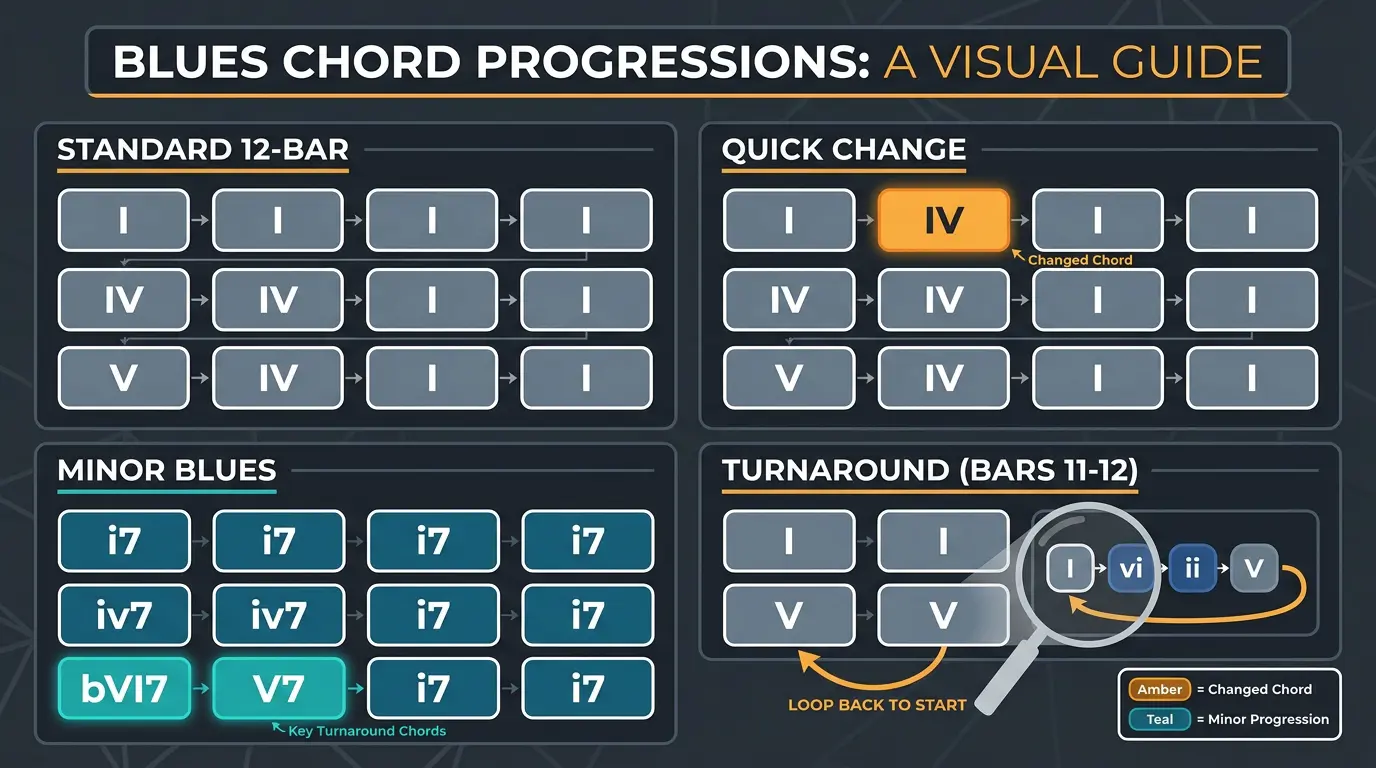
The standard grid is the foundation, but there are a handful of variants you'll run into constantly.
- Quick change: swap bar 2 from the I to the IV (I–IV–I–I to start). That early move gives the form more momentum. Common in rock and roll and jazz blues.
- The turnaround (bars 11–12): this is the runway back to the top. You can sit on V, hit V in bar 12 only, or toss in a chromatic walk. A jazzier option is a I–vi–ii–V cadence.
- Minor blues: moody and great for it. The third block uses a bVI7 moving to V7 instead of the usual V–IV. A plain grid: i7 / i7 / i7 / i7 / iv7 / iv7 / i7 / i7 / bVI7 / V7 / i7 / i7.
- Length variants: eight-bar and sixteen-bar blues exist too. Same ingredients, different runtime.
Jazz blues also adds ii–V movement and more substitutions, especially in that third line. Same bones, fancier outfit.
Feel and how to solo over it
People nail the chords and then play it dead straight, and it just doesn't sound right. Most blues swings or shuffles — a long note followed by a short note, that rolling, skipping feel — rather than even eighth notes. Put the backbeat on 2 and 4 and you're most of the way there.
For soloing, reach for the minor pentatonic plus the flat-5 blue note: 1, b3, 4, b5, 5, b7. That extra b5 is what makes a line sound properly bluesy instead of just correct. Let's give it a listen against a shuffle backing track and you'll hear it click into place.
12-bar blues at a glance
- Three four-bar blocks: I-I-I-I, then IV-IV-I-I, then V-IV-I-V.
- Use the I, IV, and V system to transpose it into any key instantly.
- Dominant 7th chords, even on the I, give the blues its signature color.
- Most blues shuffles with a long-short feel rather than playing straight eighths.
Frequently Asked Questions (FAQs)
Do all 12 bars use the I chord?
No. Only the first four bars sit on the I chord. After that you move to the IV in bars 5 and 6, return to the I, then hit the V and IV in the final block. Thinking all twelve bars are the I is the most common beginner mistake.
Is there only one correct 12-bar blues progression?
No, there are several valid versions. The standard grid, the quick change, the minor blues, and jazz blues are all legitimate twelve-bar forms. They share the same I-IV-V skeleton but differ in details like bar 2, the turnaround, and chord substitutions.
Does bar 12 have to be the I chord?
No. Bar 12 is often a V-chord turnaround, especially when you're looping or jamming, because the V pulls you back to the top. Use the I in bar 12 only when you actually want the song to end. Both are correct.
What chords are in a 12 bar blues?
A 12 bar blues uses the I, IV, and V chords of whatever key you're in, usually played as dominant 7th chords. In the key of A, that's A7, D7, and E7. The 7ths are characteristic but optional — plain major chords work too.
Who invented the 12 bar blues?
No single person invented it. The 12 bar blues emerged from the oral tradition of African American communities in the Deep South toward the end of the 19th century. Composer and bandleader W. C. Handy was the first to write it down and codify the form for other musicians.
Final Thoughts
The 12 bar blues looks simple on paper, and that's the point. Three chords, three blocks, a loop — but the feel and the phrasing are where the real work lives. Learn the grid in a couple of keys, lean on the dominant 7ths, and let it shuffle.
Once it's under your fingers you'll start hearing it in songs you've known your whole life. If you want to dig deeper into the form and its history, the Wikipedia entry on the twelve-bar blues is a solid read. Now go play it.
Some of the links within this article are affiliate links. These links are from various companies such as Amazon. This means if you click on any of these links and purchase the item or service, I will receive an affiliate commission. This is at no cost to you and the money gets invested back into Audio Sorcerer LLC.