Bad audio sinks a video faster than bad footage ever will. People will forgive a slightly soft shot. They won't sit through ten minutes of muffled, echoey, room-noise mush.
So here's a short, honest list of five microphones for vlogging. Each one suits a different way of shooting. There's no fake hype here, and no single right answer.
The best pick for you comes down to one thing: how you actually shoot. On a phone? On a camera? Running around and talking on the move? Keep that in mind as you read, and let's get to the list.
TABLE OF CONTENTS
How to pick a vlogging mic
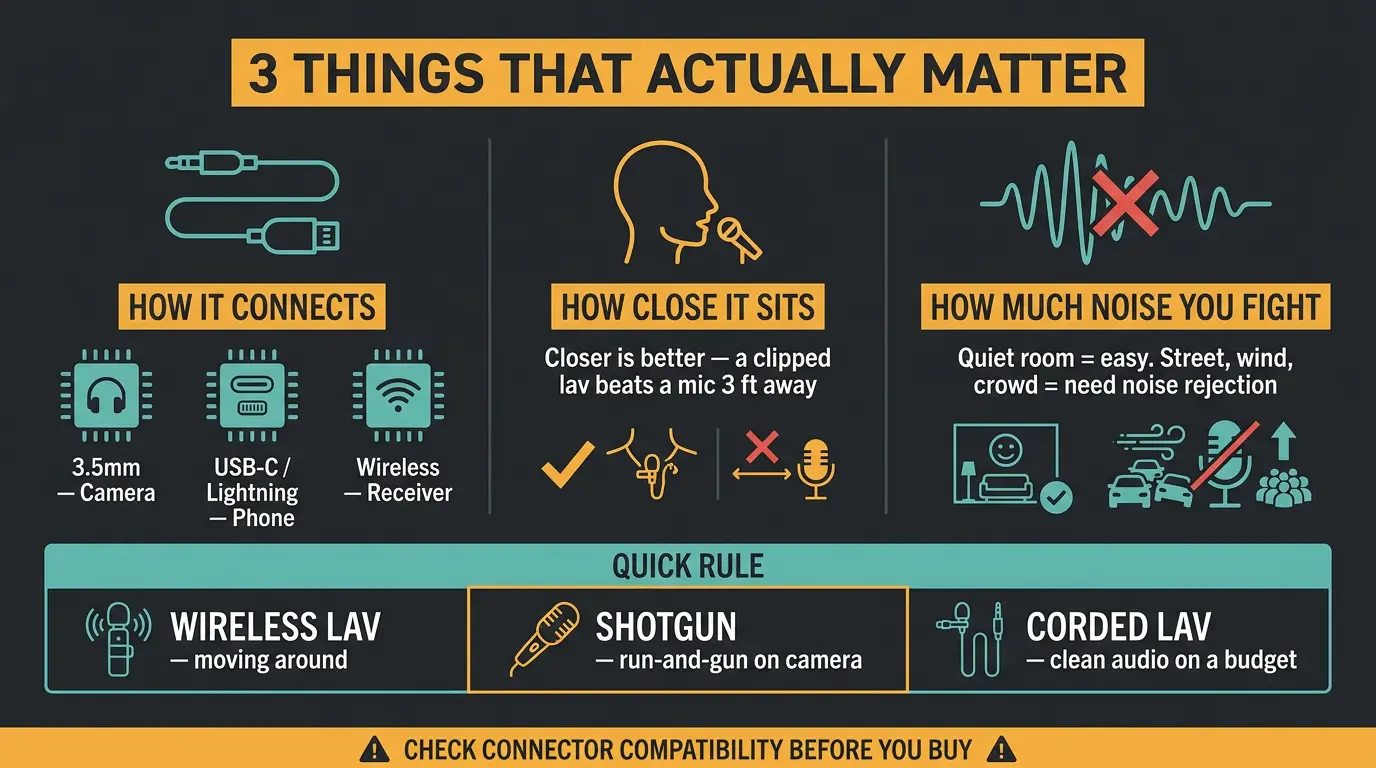
Three things actually matter when you're buying a vlogging mic. Everything else is detail.
- How it connects. Camera mics usually run on a 3.5mm jack. Phone mics need USB-C or Lightning. Wireless systems pair to a little receiver that plugs into either. Get this wrong and your mic literally won't work with your device.
- How close it sits to your mouth. Closer is almost always better. A lav clipped to your shirt beats a mic three feet away, every time.
- How much background noise you fight. Quiet studio? Easy. Busy street, wind, a crowd? You'll want noise handling and a mic that rejects room sound.
As a rough rule: wireless lavs win when you're moving around, shotguns win for run-and-gun on camera, and corded lavs win when you want clean audio without spending much. If you want to go deeper on the shotgun side, we have a full guide to the best shotgun microphones.
One more thing, and it trips up a lot of people. Make sure you check connector compatibility before you buy. A ton of older lav kits are Lightning-only and won't work with current USB-C phones. Read the listing carefully.
RØDE Wireless GO (3rd Gen)

#1
Best Overall
RØDE Wireless GO (3rd Gen)
The Wireless GO (3rd Gen) takes most of what made the Wireless PRO great and packs it into RØDE's smaller, power-on-and-go body. The headline is 32-bit float recording onboard each transmitter, which means you basically can't clip or undershoot your levels — both extremes are recoverable in post, and you get up to 40 hours of backup on 32GB. You also get longer range (around 850 feet), upgraded omni mics borrowed from the PRO, GainAssist to handle your output levels, locking 3.5mm inputs, and headphone monitoring off the receiver. The one real gap versus the PRO is timecode — if you don't need it for multicam sync, you're not missing much here.
Pros
- 32-bit float onboard recording means you can recover clipped or quiet audio in post
- Upgraded mics and GainAssist make it genuinely point-and-shoot
- Locking inputs, headphone monitoring, and ~850ft range are real practical upgrades
Cons
- No timecode — that stays exclusive to the Wireless PRO
- Base kit includes only a charging bar; the Charge Case+ and lav mics are separate
Shure MV88+ Digital Stereo Condenser Microphone

#2
Runner-up
Shure MV88+ Digital Stereo Condenser Microphone
The MV88+ is a digital stereo condenser that ships as a video kit, with cables for both phone and computer. If you're a talking-head vlogger shooting on a phone and you want stereo or adjustable polar patterns, this is a strong fit. The patterns let you dial in how much of the room you capture versus just your voice.
One honest note: it uses an electret capsule, and that design has been around a while. The membrane in electret mics does slowly degrade over time, but a fresh unit gives you plenty of capsule life ahead of it. Nothing to worry about on a new purchase.
Quick clarification, because Shure's naming is a maze. This is the MV88+ Video Kit, not the older iOS-only MV88/A that got discontinued. Shure also has a brand-new USB-C MV88 now, but it's very recent and short on independent reviews, so I'd let that one mature before chasing it.
Pros
- Stereo capture with selectable polar patterns
- Comes as a full video kit for phone and computer
- Solid, detailed sound for talking-head work
Cons
- Electret capsule design is older
- Confusing naming across the MV88 line
Hollyland Lark M2

#3
Top Pick
Hollyland Lark M2
The Lark M2 is Hollyland's button-sized wireless lav system, and the headline is the size — each transmitter weighs about 9 grams, light enough that it won't drag your shirt down. It's pre-paired at the factory and basically plug-and-play, with 24-bit/48kHz audio, a 70dB signal-to-noise ratio, and genuinely clean voice reproduction that punches above its size. Hollyland advertises 300m of range, but real-world testing puts it closer to 200 feet before your own body starts interrupting the signal — so treat the big number as a best-case, not a promise. For vloggers, podcasters, and interviewers who want easy wireless audio without the bulk, it's an easy one to recommend.
Pros
- Tiny, discreet 9g transmitters that won't sag clothing
- Pre-paired and nearly setup-free
- Clean, natural voice with a low noise floor
- Wide device support plus UAC, so no external sound card needed
Cons
- Range claims are optimistic — expect closer to 200 feet in practice
- Magnetic-only attachment is easy to knock off accidentally
Movo VXR10-AI v2

#4
Top Pick
Movo VXR10-AI v2
The VXR10-AI v2 is a compact on-camera shotgun mic with built-in AI noise cancellation, and that AI is the whole pitch — Movo says it's trained on over 700,000 samples to strip out wind, traffic, chatter, and HVAC hum. It does dual duty over both 3.5mm analog and USB-C digital, so one mic covers your camera, phone, and computer, which is genuinely handy for mobile creators. The supercardioid pattern keeps your subject up front, and the included Rycote Lyre shockmount and furry windscreen are real accessories, not filler. With that being said, AI noise reduction always involves a tradeoff — at least one user noted it can make a voice sound a little funny, so make sure you test it on your own voice before committing to it for a real shoot.
Pros
- AI noise cancellation that targets wind, traffic, and chatter
- Works across camera, phone, and computer via 3.5mm and USB-C
- Comes with a Rycote Lyre shockmount and furry windscreen
Cons
- AI processing can make some voices sound a bit unnatural
- Battery drops to about 10 hours with AI active
MayBesta Professional Wireless Lavalier/Lapel Microphone

#5
Lowest Price
MayBesta Professional Wireless Lavalier/Lapel Microphone
This MayBesta lav is about as plug-and-pair as it gets. You plug the receiver into your device, turn on the mic, and the two parts connect automatically. No app, no Bluetooth pairing dance, no setup. For a first-time vlogger who just wants clean lav audio, that simplicity is the whole appeal.
Now the big honest flag, and please read this part twice. The most common version is Lightning-only and will not work with USB-C iPhones — that's the 15, 16, and 17 — or USB-C iPads. If you grab the wrong one, it simply won't connect.
MayBesta does sell USB-C and Android variants, including the WM150, WM355, and WM356. Make sure you buy the version that matches your phone's port. Get the right SKU and it's a tidy little wireless lav for the money it takes to get started.
Pros
- Truly automatic plug-and-pair, no app needed
- Easy entry point for first-time vloggers
- Available in versions for different ports
Cons
- Common SKU is Lightning-only — won't work with USB-C phones
- Build and sound aren't on the level of pricier picks
| Mic | Type | Connection | Best for |
|---|---|---|---|
| Rode Wireless GO III | Wireless transmitter mic | Wireless (camera or phone) | All-around reliable audio, anywhere |
| Shure MV88+ | Digital stereo condenser | USB-C / Lightning | Talking-head vloggers on a phone |
| Hollyland Lark M2 | Wireless lavalier | Wireless (camera or phone) | Moving around on a tighter budget |
| Movo VXR10-AI v2 | Shotgun | 3.5mm | Run-and-gun on a camera |
| MayBesta Lavalier | Wireless lavalier | Lightning or USB-C (check SKU) | First-time vloggers wanting simple lav audio |
Frequently Asked Questions (FAQs)
Do I need a wireless mic for vlogging or will a shotgun do?
A shotgun is fine if you stay close to your camera and don't move much. Go wireless if you walk around, shoot at a distance, or want the mic close to your mouth while the camera stays back. Movement is the deciding factor, not budget.
Will these mics work with my phone if it has USB-C?
It depends on the mic and its connector. The Shure MV88+ and Movo's newer AI version offer USB-C, and the wireless systems work through their receivers. But many lav kits, including the common MayBesta version, are Lightning-only and won't work with USB-C iPhones. Always check the connector first.
What's the difference between a lavalier and a shotgun mic for vlogging?
A lavalier clips to your shirt and stays close to your mouth, so it sounds consistent even if you move. A shotgun mounts on the camera and points at you, capturing voice plus some room. Lavs win for movement and consistency; shotguns win for quick, simple on-camera setups.
Is the Rode Wireless GO II still worth buying now that the Gen 3 exists?
Yes, the Wireless GO II is still very much worth buying. It's reliable, widely sold, and covered by Rode's 5-year warranty. The Gen 3 adds 32-bit float recording, which matters if you worry about clipping, but the GO II delivers clean audio for the vast majority of vloggers.
Can I record clean audio outdoors when it's windy?
Yes, with the right help. Use a foam or furry windscreen on your mic, since most kits include one. Mics with noise cancellation like the Hollyland Lark M1 help too, and the newer AI-driven options handle wind better. A bare capsule in wind, though, will always sound rough.
Final Thoughts
There isn't one mic that wins for everybody here. The Wireless GO III is the safe all-around bet, but if you're glued to a phone, the MV88+ makes more sense, and if you just need cheap clean audio to start, a lav gets you going. Match the mic to how you shoot and you'll be happy.
Whatever you grab, get it close to your mouth and trust your ears on the playback. Less is more — a clean, simple signal beats a fancy mic fighting a bad setup every time.
Some of the links within this article are affiliate links. These links are from various companies such as Amazon. This means if you click on any of these links and purchase the item or service, I will receive an affiliate commission. This is at no cost to you and the money gets invested back into Audio Sorcerer LLC.